
Martin Wheatley
Founder, The AI Leader Lab · CIMA Qualified · Managing Director, Rawson Ellis
Leadership Question: Where does accountability actually sit when AI informs decisions?
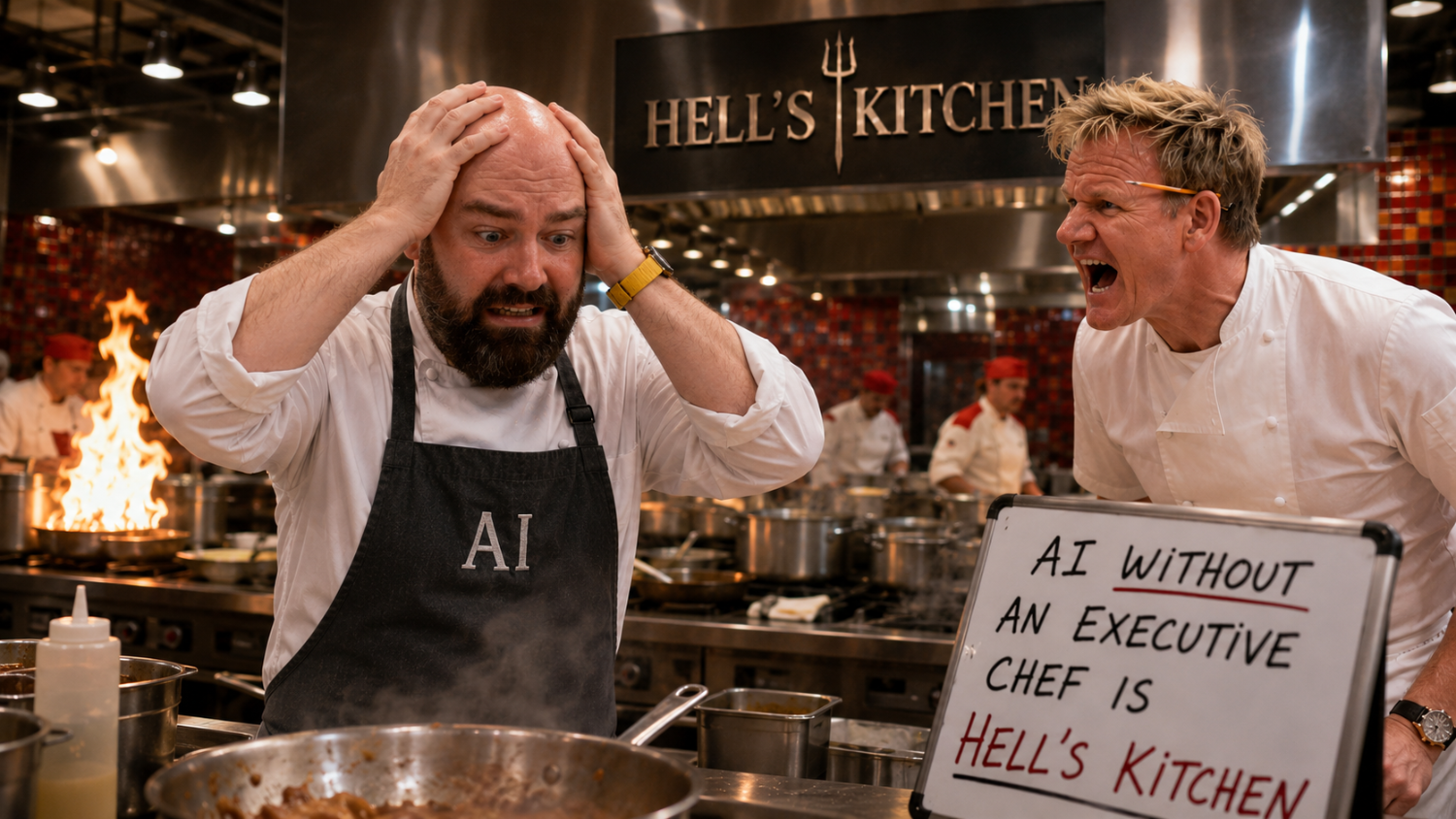
Early Answer: AI concentrates accountability on the most senior level, whether leaders acknowledge it or not.
Picture the scene; you're in a board meeting when a decision goes sideways, and the outcomes are being questioned. There's a familiar shuffle happening; people deferring, process cited, consensus invoked. Then someone says, "but the model recommended it."
That phrase used to carry weight, a kind of conversational shield. But not anymore.
What's changed isn't the presence of technology. It is how accountable you are now to knowing that technology isn't the excuse.
Senior leadership accountability for AI governance is increasing. More than a coincidence, it feels like a regulatory reality, and the expectations of boards are changing. The accountability structure is changing faster than most organisations can articulate. (Commission, 2025)
Organisations traditionally believed that accountability could be shared. Shared ownership sounds mature, collaborative, and sophisticated. "We agreed on this, the team decided, we leveraged the data." These phrases still feel professional and defensible. But the moment AI is involved, it doesn’t feel that way anymore.
When something goes wrong in an AI-shaped decision, the first question from a board, a regulator, or a journalist is not going to be: "What did the model say?" It will be: "Who made the decision?" And more pointedly: "could a responsible leader, knowing what they know now, have made a different call?"
Leaders are already starting to feel the exposure, but they're not always naming it. Decisions are being accelerated, delegating to AI-informed processes, building consensus, hiding a little behind the authority of "the data" or "the model." When outcomes are questioned, as they will be, the structure that felt safe and distributed suddenly feels fragile and personal.
The leadership risk isn't complicated. When accountability is assumed to be shared between people, systems, and models, no one is truly accountable when outcomes are questioned. Blame diffuses, post-outcome justification replaces a solid, defensible explanation, and a board that is more concerned than reassured.
Why is this happening now? The last couple of years have seen companies trialling generative AI. As use cases have become more specific and defined, AI increases speed, assumed certainty, and delegation pressure faster than your leadership teams and culture can evolve.
A scenario model can be run in minutes, insights from data can be found in hours, and consensus around recommendations can be made in days. (Integrating artificial intelligence into scenario analysis: a validated framework for strategic planning under economic uncertainty, 2025). But your accountability systems (who owns what, how decisions are explained, what remains non-delegable) haven't evolved at the same pace.
Where leaders can go wrong is treating AI recommendations as neutral input when they're not (they’re affected by training data, design choices, and assumptions), allowing ownership to emerge after outcomes land, or hiding behind process and consensus when things go wrong.
Good judgment can be made straightforward. A named leader owns the decision. Not the team, not the model, but a single person who can explain the rationale of the decision. They cannot just defend the data; they must also be able to explain why this choice was the right one given the organisation's values, risk tolerance, and business position. Accountability stays stable before and after outcomes.
The guardrails look like this:
- Decision ownership is declared before work begins. Name who will own this outright. Don't let it emerge organically.
- AI is used as input, not authority. The models can surface options and risks, but the named leader decides.
- Accountability is unchanged post-outcome. The decision owner doesn't shift when results land.
The standard this sets is unambiguous. If accountability feels shared, it is already unsafe. When someone in your leadership team says "we decided," but you suspect they're actually saying "I can hide in this," that's the moment your accountability structure has failed. It won't hold in a crisis, it won't satisfy a board, and it won't survive under scrutiny (internally or externally).
Organisations now need to rebuild that clarity. Not through governance documents or regulatory compliance structures, but by asking a simple question: if this decision fails, and I'm sitting in front of the board, regulator, a client, or our shareholders, can I point to the person who made this call and explain why they made it?
If the answer is a clear yes, then your accountability structure is sound.
If the answer is anything other than 'yes,' you have exposure that no amount of process will fix.
AI isn't removing the need for that clarity; it is exposing the cost of living without it.
References
Commission, N. B. (May 27, 2025). Governance of AI: A Critical Imperative for Today’s Boards. Harvard Law School Forum on Corporate Governance. https://corpgov.law.harvard.edu/2025/05/27/governance-of-ai-a-critical-imperative-for-todays-boards-2/
(2025). Integrating artificial intelligence into scenario analysis: a validated framework for strategic planning under economic uncertainty. Global Economics Research 1(2). https://doi.org/10.1016/j.ecores.2025.100007