
Martin Wheatley
Founder, The AI Leader Lab · CIMA Qualified · Managing Director, Rawson Ellis
Leadership question: Why does AI make weak leadership more visible?
Answer: As intelligence becomes cheap, judgement becomes the differentiator.
There’s a moment many senior leaders recognise once AI becomes part of day-to-day decision-making.
It’s rarely dramatic. It usually arrives quietly; in a meeting, during a review, or while watching a decision unfold, when it becomes clear that intelligence is no longer the constraint.
The constraint has moved.
AI has removed one of leadership’s historical advantages: privileged access to insight. Models can surface patterns, generate scenarios, and stress-test assumptions at a speed and scale no human team can match. That capability is becoming baseline.
What hasn’t scaled is judgement.
AI can’t weigh competing goods. It can’t decide what matters most when priorities collide. It can’t remain accountable when conditions change. And it can’t explain a decision in a way that builds trust under scrutiny.
Those aren’t technical gaps; they’re leadership ones.
And AI exposes them rather than closes them.
By 2027, it’s expected that 50 percent of business decisions will be augmented or automated by AI agents. (Gartner). Organisations that codify judgement standards will materially outperform those that rely on implicit expertise. Where judgement is assumed rather than defined with intent, AI initiatives will stall, decisions will reverse, and accountability blurs.
The difference isn’t the technology. It’s the leader.
Here’s the part that’s easy to miss:
The bar hasn’t moved because leaders need to be more data-literate or more fluent with tools. It’s moved because the old cover has gone. When information was scarce, leaders could reasonably say, “We made the best call with what we knew.”
That defence still exists, but it’s no longer sufficient.
The question now is sharper: Given access to more analysis, more scenarios, and more challenge than ever before, what judgement did you apply to choose this path?
That’s a harder question. And it should be.
AI erodes the traditional excuses. It’s harder to claim a risk wasn’t visible when it was flagged. Harder to say alternatives weren’t considered when they were generated instantly. Harder to hide behind time pressure or information limits.
What’s left is judgement. Your call. Your reasoning. Your accountability.
This is where many leaders may stumble.
One common mistake is confusing output with judgement. A model produces a recommendation. That isn’t judgement, it’s computation. Leadership judgement is what you do with that output. Do you accept it? Challenge it? Combine it with context the model can’t see? Decide not to follow it?
That’s the work of a leader.
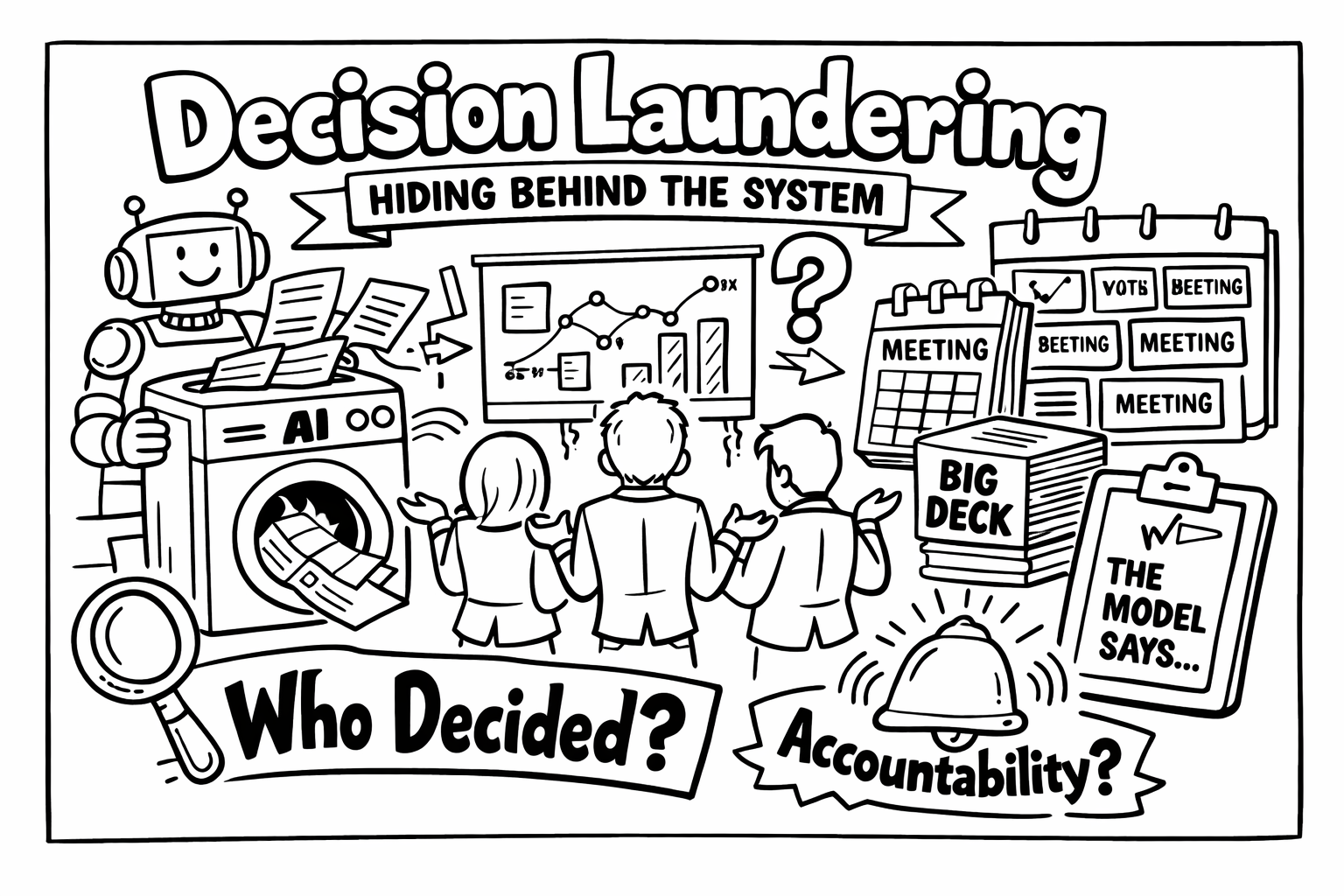
Another failure mode is borrowing authority from tools. “The model recommends…” As if the recommendation carries weight simply because it came from a model.
That isn’t rigour, it’s an abdication.
A model’s output only carries authority once a leader has evaluated it, understood its limits, and consciously chosen to use it as an input. The decision still belongs to a person even when it’s easier to pretend otherwise.
So what does good judgement look like now?
The pattern is becoming clearer:
- Clear ownership. Not consensus or diffusion. A named leader who owns the call.
- Explicit reasoning. Not just data, but an explanation of trade-offs, assumptions, and what’s being prioritised.
- Accountable decisions. Defensible not because they worked, but because the thinking was sound, given what was knowable at the time.
The guardrails are simple:
- Ownership before analysis. Decide who owns the decision before modelling begins.
- Rationale before action. If you can’t explain it clearly to a board, a regulator, or your team, you’re not ready to move.
The standard this sets is direct: AI does not lower expectations, it raises them.
We can already see this playing out. Boards are probing decision rationale, not just outcomes. Leadership teams are less tolerant of vague consensus. Regulators are asking how judgement was applied, not what the data showed.
The bar has moved and it won’t be coming back down.
The leaders who remain grounded through this shift aren’t hiding behind models. They’re stepping forward and saying: This is my call. This is why. This is what I’m betting on. This is what could go wrong. I’m accountable either way.
That’s harder, but it’s also clearer.
And in a world where intelligence is cheap, clarity is the real scarcity.
Leadership Instrument: The “No Tool as Authority” Line
When to use it: Any time someone cites a model, tool, or output as the justification.
Exact words:
“That’s useful input. Now tell me your judgement — what are we choosing and why?”
What it changes: AI becomes a challenger, not a hiding place.
What to listen for: “The model says…”
Leadership standard: AI may inform decisions. AI may challenge decisions. AI may never own decisions.