
Martin Wheatley
Founder, The AI Leader Lab · CIMA Qualified · Managing Director, Rawson Ellis
Leadership Question: What happens when leaders hide behind systems instead of judgement?
Answer: AI makes it easier to launder decisions and to look rigorous while avoiding ownership.
You can often spot the problem in the calendar before you see it in the results.
Three pre-meetings.
Two “alignment” calls.
A deck that grows by ten slides a day.
Careful language everywhere.
And then a decision that somehow feels agreed without being owned.
This is one of the most predictable failure patterns in senior leadership teams. Not because people are dishonest, and not because they lack competence, but because ambiguity is socially convenient.
A decision is “made”… …but no one has quite taken responsibility for it.
It’s wrapped in data. Supported by analysis. Signed off in language that sounds responsible.
And when it goes wrong, which it eventually does, the first real question arrives:
Who actually decided?
That’s when the room gets quiet. Not because people are evasive. But because the organisation has normalised moving decisions forward without requiring anyone to stand behind them.
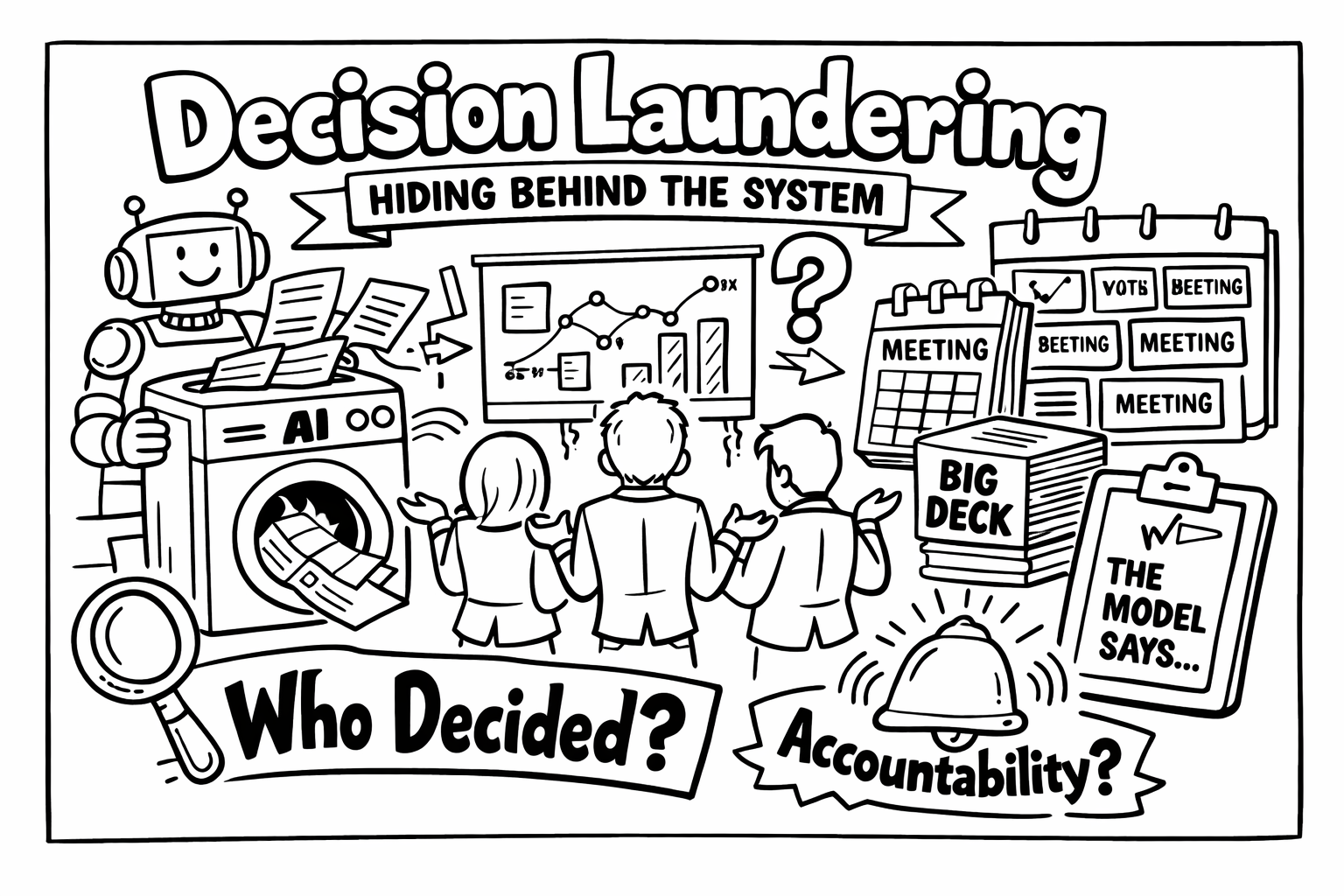
That’s decision laundering.
Decision laundering is what happens when process, consensus, and “the model suggests…” become a substitute for judgement. The decision feels legitimate because it’s been through the machine but it isn’t defensible because accountability has been diluted into the room.
AI doesn’t create this behaviour. It accelerates it.
AI increases options, confidence, and the ease with which analysis can be produced. It makes it trivial to generate work that looks like rigour. And in doing so, it quietly shifts the centre of gravity in meetings.
Because when analysis is cheap, meetings stop being about ownership and start being about plausibility.
Leaders spend more time discussing what can be justified than what will be owned.
That’s how decision laundering creeps in.
It rarely starts as avoidance. It starts as a language shift.
You hear it in phrases that sound reasonable and responsible:
“The model recommended it.” “We aligned as a group.” “The data supports this.” “It’s what the process says.”
Each sentence moves accountability one step further away from a human being.
And organisations are very good at teaching people which language keeps them safe.
If plausibility is rewarded more than ownership, people will optimise for plausibility. They’ll bring more slides. More analysis. More pre-alignment. More comfort.
Not because they’re weak. Because the incentives are real and over time, this creates a subtle but damaging cultural drift.
If senior leaders don’t explicitly own decisions, mid-level leaders learn that safety comes from diffusion. They learn to escalate not by threshold, but by discomfort. They learn that being involved matters more than being responsible.
And so the organisation becomes slower even as the tools become faster.
More meetings. More reassurance-seeking. More post-hoc justification. Less clarity.
What’s dangerous about decision laundering is that it often looks like maturity from the outside. The organisation appears thoughtful. Measured. Well-governed. Until pressure arrives.
Boards, regulators, investors, or post-incident reviews don’t interrogate process. They interrogate judgement.
They ask who decided and why that decision was reasonable at the time.
This is where laundered decisions collapse.
The fix is not more process. It’s stronger leadership behaviour.
Good judgement is almost boring in its clarity:
- “This is my decision.”
- “Here are the assumptions I’m making.”
- “Here’s what I’m uncertain about.”
- “Here’s what could go wrong and what we’ll watch.”
- “If this fails, I own it.”
That’s uncomfortable. And it’s the only form of leadership that holds when speed increases and scrutiny arrives.
AI will continue to make analysis faster, cheaper, and more persuasive.
The leadership question is whether it also makes judgement clearer or simply gives people somewhere else to hide.
If no one can say “this was my call”, leadership hasn’t been shared. It’s been avoided.
Leadership Instrument: The Ownership Line
When to use it: Before analysis deepens; before alignment becomes a substitute for deciding.
Exact words:
- “This decision is owned by ___, and they will stand behind it.”
If that sentence feels awkward, the decision isn’t ready.
What it changes: Ownership becomes expected, not volunteered.
What to listen for: “Are we comfortable?” “Let’s just get aligned.” Those are signs nobody wants to own the call.
Leadership standard: If no one can say “this was my call,” leadership has already failed, even if the documentation is immaculate.