

Martin Wheatley
Founder, The AI Leader Lab · CIMA Qualified · Managing Director, Rawson Ellis
Uber switched on AI coding tools for around 5,000 engineers this year and set a budget to cover the full twelve months.
It lasted a grand total of four months.
Somewhere between $500 and $2,000 per engineer per month, an entire year's allocation gone by spring, and a $1,500 monthly cap per person hastily bolted on afterwards. I'd normally file that under "big tech problems". But the same week I read it, KPMG published UK figures that brought it much closer to home: a third of UK leaders admit limited understanding of how AI costs are structured, tokens included, and 42% say they've only got partial visibility of what their organisation is actually spending.
So, I've done some analysis below.
Worth mentioning that the costs discussed here are the cost of API usage of the models (when the models are used via an interface rather than within the model itself), or the additional usage of models after any subscription allowances run out. The subscription charge per month, will be the default monthly subscription charge for many people, before additional usage at API rates kick in. It just depends on scale and what is being built.
The flat-rate deal is ending
On 7th July, Anthropic was meant to move its newest Claude model behind usage credits for subscribers, months after it started metering third-party agent tools on paid plans. That date has since been extended so who really knows when or whether it will move behind an additional usage cap.
OpenAI went the other way, keeping things bundled, but listen to how Sam Altman described it: buy credits when you hit your limits on Codex from 2025, because "it will let us keep subscription prices low for most users and let the rest of you go wild."
Different answers but with the same admission.
The all-you-can-eat era started closing some time ago but is picking up speed now.
And I don't think it's greed, particularly. These firms have spent staggering sums building their models and they have to claw that investment back somehow. A flat £20 subscription works when people chat with the thing a few times a day. It collapses when software starts using it thousands of times an hour. Which is exactly what's now happening.
The unit you're billed in
A quick plain-English version, because this is the bit most of us were never told.
AI models read and write in tokens, chunks of roughly three-quarters of a word. Everything you send in (input tokens) gets counted, and everything the model writes back (output tokens) gets counted at a much higher rate, typically five times more. On Claude's top model that's $10 per million tokens in, $50 per million out.
The catch is the thinking (or inference). Reasoning models work through a problem internally before answering, and that internal working is billed at the expensive output rate even though you never see it. A maths question with a 200-token answer can burn 3,000 tokens of hidden thinking behind it.
You pay for the answer. You pay a lot more for the thought process.
Cheaper per token, dearer per month
Now, the strange bit. Tokens have never been cheaper.
What cost $60 per million in 2021 costs pennies now, and the price of matching any fixed level of capability has been falling at something like tenfold a year, often faster.
On 8 July, SpaceXAI launched Grok 4.5 at $2 in and $6 out, and claims it performs near the frontier at a fraction of the price. Meta and the Chinese labs are pushing the same direction.
Just look at the spread in what the main models charge today:
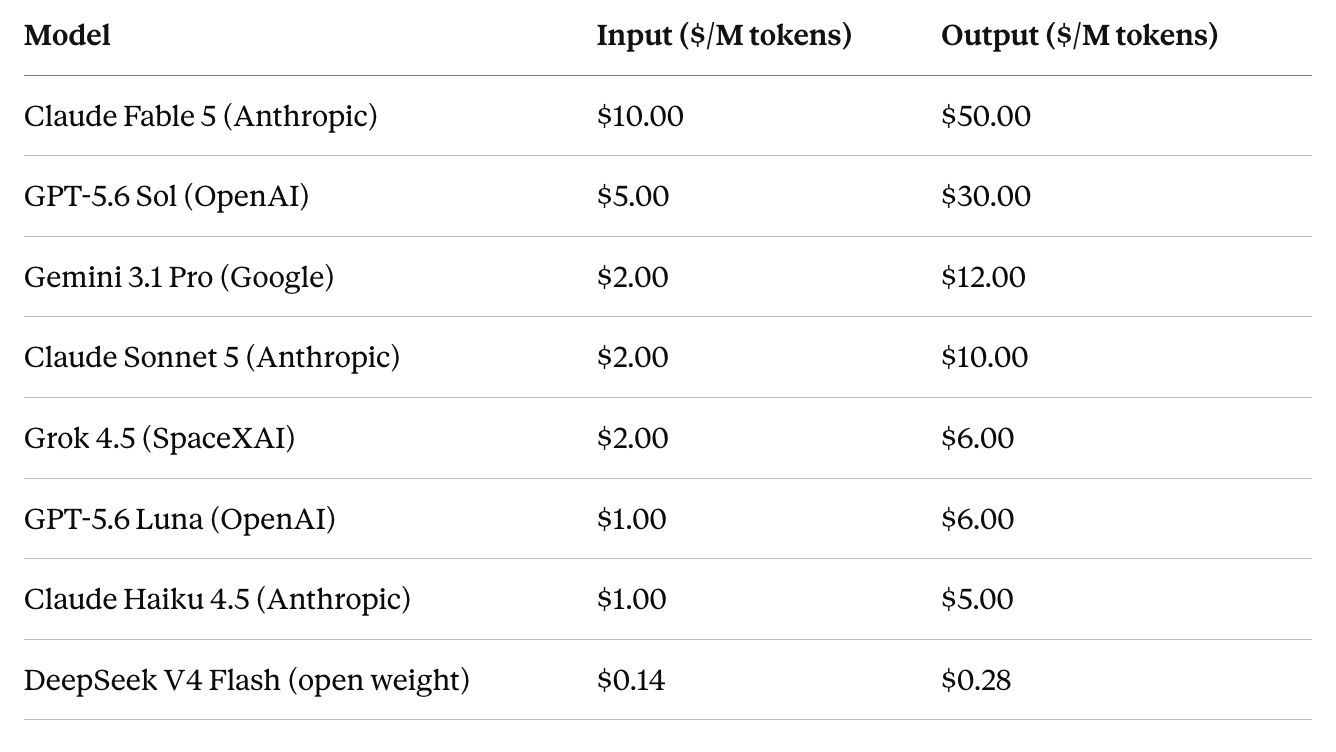
The top of that table charges roughly 180 times the bottom for the same million tokens out. Even staying inside one vendor, the gap is tenfold. And yet the bills keep going up.
That's Jevons Paradox, the old observation that when something gets cheaper, we don't spend less on it. We use vastly more of it.
Like the toddler in the film this piece is named after, the thing itself didn't change. It just got very big, very fast.
The cost per token has definitely dropped. The number of tokens we're all using has exploded, because agents, the AI that does work rather than answers questions, burn through 5 to 30 times the tokens of an ordinary chat.
I ran some back-of-envelope numbers on this at Anthropic's Fable 5:
- A drafted email costs about 2 cents on the dearest model on the market. Pennies, honestly.
- But a heavy user's month comes out near $27.50 at API rates, which is more than their $20 subscription.
- And one serious agent run, a 40-step task with the model re-reading its context at every step, lands around $5.50. A single run. Costing more than a month of one person's emails.
Multiply that across a business and Uber's four months stops looking careless.
What I'm actually doing about it
Firstly these are API/token rates, and most of what I do is inside a subscription, (for now at least anyway). So the cost variances are not fully impacting me. Albeit, the usage caps within the subscription tiering in Claude and OpenAI does, so it's essentially the same logic.
The practical skill is matching the model to the task, because the price gap inside one provider is now tenfold.
My pattern at the moment: use the frontier model (Anthropic's Fable 5 or OpenAI's Sol) to plan a piece of work meticulously, then hand the routine middle to something far cheaper (Anthropic's Sonnet or OpenAI's Terra). At the end I clip back to the frontier model for a verification pass. Frontier judgement at the start and finish. Bulk work at bulk rates. I'm still refining where the handover points sit, but the logic holds.
The other thing is budgeting, and here I'll be honest: a token cost is very hard to pin down until after the fact. I couldn't have told you what my newsletter workflow cost before I'd run it a few times and read the meter. So run the task and read the meter before setting a budget. Not the other way round.
A rule from my own client work applies here too. I sat with a charity a while back weighing a Copilot rollout: roughly £1,000 a month for 29 licences, when maybe three people would use it daily. £100 for five used licences beats £1,000 for 24 unused ones.
Pay for used capacity. The token era just makes that rule sharper if you're using API rates.
Does this apply to you yet?
Maybe not. If your teams use Microsoft Copilot to tidy documents and summarise meetings, the vast implications can wait. The sensible move there is probably just squeezing full value out of what's already being paid for on a normal subscription tier.
The moment it changes is the moment someone starts building agents, or brings Microsoft Copilot Cowork, into your operations that rely on API or token based billing.
T
Token burn multiplies and individual usage becomes wildly uneven. Caps and per-person limits are far easier to design in at the start than to retrofit after the first eye-watering invoice. Just ask Uber.
One last thought. Everything above is a financial lens, and it's worth having. But I don't think cost is always the measure that matters most. The firms getting this right are watching business outcomes, workflow by workflow: did it ship more product, did it bring in more revenue, did it increase efficiency and throughput. You can't see whether a workflow was genuinely transformed from the cost line alone. That one deserves its own article, so I'll come back to it.
For now, a question I've started asking myself, and it's harder than it sounds: if everything switched to token billing, what did my most-used AI workflow cost me last month, and would I notice if it doubled?
♻️ Enjoy this? Repost to your network if you found this useful.
🔔 Follow Martin Wheatley more AI for leadership.
✅ 𝙃𝙚𝙡𝙥𝙞𝙣𝙜 𝙡𝙚𝙖𝙙𝙚𝙧𝙨 𝙗𝙚𝙘𝙤𝙢𝙚 𝘼𝙄-𝙘𝙤𝙣𝙛𝙞𝙙𝙚𝙣𝙩. Putting AI to work with your people, without replacing what makes them great.
*Prices checked 10 July 2026 against Anthropic, OpenAI and Google pricing pages; GPT-5.6 and Grok 4.5 from launch reporting. Sonnet 5 is introductory pricing until 31 August. DeepSeek's first-party API trains on your data, which is its own conversation.