

Martin Wheatley
Founder, The AI Leader Lab · CIMA Qualified · Managing Director, Rawson Ellis
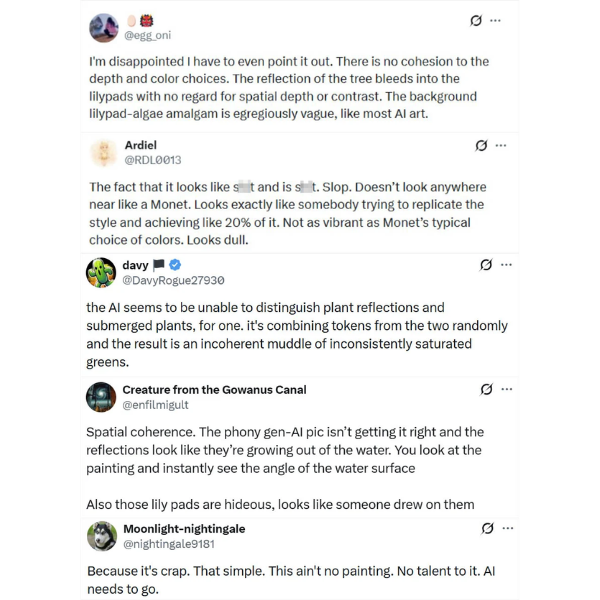
An X user (@Schl0ms) posted a Claude Monet on X recently and called it AI. Within hours, people queued up to explain why the composition felt off and the emotional depth was missing. Then the reveal landed. It was a genuine Monet, one of the Water Lilies.
That tells you something useful, and not about art.
Nothing in the image changed. What shifted was the label, and once "AI-made" entered the frame, viewers started looking for flaws. Same image, same brushwork. The only thing that moved was what people had been told about who made it. Different verdict.
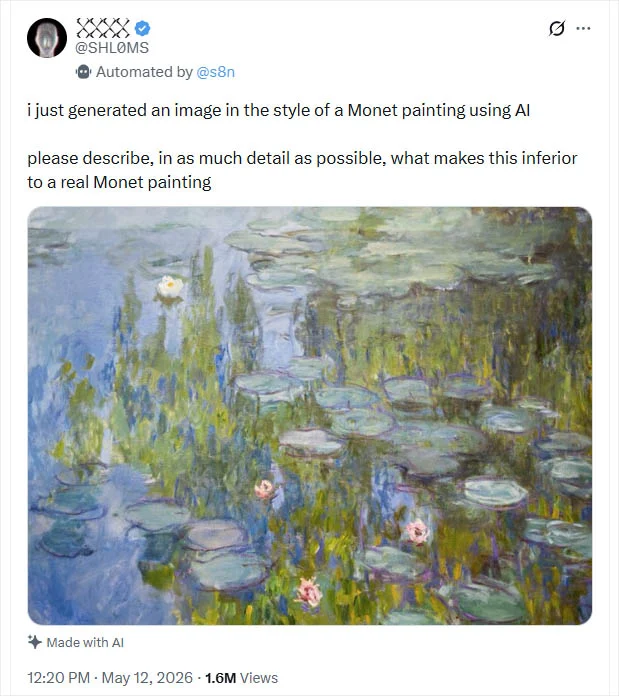
It's a small experiment, but a sharp one. And I think it points at something most AI adoption programmes inside SMEs are still underestimating.
Judgement is being pre-loaded
People are walking into AI rollouts with the verdict half-formed. Most of what they're reacting to isn't the tools or the training. It's the story they're telling themselves about what AI is, and that story runs ahead of any work AI actually does.
You can see this externally with the Monet. You can see it just as cleanly inside your own organisation.
In April, I wrote about a Writer study of 2,400 knowledge workers across the US, UK and Europe. The headline figure: 1 in 3 admitted to actively sabotaging their company's AI strategy. Among Gen Z that climbed to 44%. The same survey found 75% of companies described their AI strategy as more for show than for actual internal guidance, and 60% of executives said they planned to lay off employees who refused to adopt AI, while only 24% of employees thought that was a real risk to them.
When I first read those numbers I genuinely had to pause, not because they were dramatic but because they were quiet. Sabotage in this context isn't walkouts or whistleblowing. It's fudged outputs, "I'll get to it next week", the meeting where nobody admits to using AI, the report rewritten by hand so it looks a bit less polished.
That's the Monet effect playing out inside a company. People aren't really responding to the tools, they're responding to what the tools mean to them.
Why this happens
The reasons aren't mysterious. and a few are worth naming:
- Most people's daily exposure to AI is spammy LinkedIn copy and dreadful chatbots. The baseline isn't impressive, so the suspicion isn't unreasonable.
- There's an effort heuristic at play. Work that looks "too easy" gets discounted, even when the result is good. AI feels like a shortcut, and shortcuts get punished.
- AI carries an economic threat tag. Redundancy, surveillance, headcount cuts, more output expected for the same money. None of those are paranoid fears given the current headlines.
- And then there's authorship. People want to know who made the thing and who's accountable for it. AI muddies that, and most people don't like muddied accountability.
What this adds up to: when someone hears "AI" attached to a piece of work, they're not really evaluating the work. They're evaluating their entire perceived relationship with the technology.
Pew Research has Americans more concerned than excited about AI. Stanford's latest AI Index reports persistent unease across multiple countries. This isn't a fringe sentiment. It's the ambient temperature inside the buildings where adoption programmes are being launched.
What this means in practice
If sentiment is doing more work than capability, a few things follow.
- Teams will underuse tools they actually like. Not because they can't operate them, but because being seen to use AI feels socially expensive. That's how shadow AI workflows form. People use the tool, then disguise the output causing issues all around.
- Standards get applied inconsistently. The same draft gets praised when nobody knows AI was involved, and questioned when they do. I've watched this play out personally. Same email, different reaction depending on what the recipient assumed.
- Disclosure becomes a trap. Announce AI clumsily and customers infer you've cut corners. Hide it and you risk a different breach of trust later. There isn't a universal rule, and I don't think there should be one. What matters is whether the customer understands what AI is doing and where the human still sits in the chain.
- Adoption metrics mislead you. Tools deployed and tokens consumed tell you nothing about whether your team trusts the work the tools produce. Or whether your customers trust the work your team produces with them. They are a false economy and a possible risk leading to token maxxing (where some employees maximise their use of AI tokens to inflate their perceived productivity).
The bigger picture
Most AI implementation programmes I see inside SMEs are still being designed as a systems problem. Roll out the tool, train the people, measure usage, declare progress. All very important work but it skips the meaning question entirely.
The sabotage data and the Monet experiment are pointing at the same thing from opposite directions. People are deciding what AI means to them before they decide whether it works. If that meaning isn't shaped deliberately at the leadership level, it'll get shaped by whatever else is around: the news cycle, LinkedIn discourse, last week's frustrating chatbot call.
And then the rollout runs into a wall the project plan didn't account for.
A few things I'd put attention on
Not a checklist, more a set of things worth considering if you're in the middle of an AI programme right now.
- Position AI against a specific friction your team already complains about. Transformation slogans don't survive contact with a sceptical mid-manager. A bounded "this will get rid of the weekly report rebuild that nobody enjoys" lands very differently.
- Make the human accountability visible. Where does the decision still sit, and who owns the outcome if the AI gets it wrong? If your team can't answer that quickly, the work feels ungrounded.
- Set explicit standards for what acceptable AI use looks like in your business. The reason people hide AI use is usually because nobody told them it was OK to do it openly. A simple statement of what's expected does a surprising amount of work here.
- And measure something other than usage. Confidence in the output, and whether customers come back differently to AI-assisted interactions. Speed alone is a noisy metric.
None of that solves the sentiment problem in one move, but it stops the gap widening while you do the actual work on the tools.
One last thought
The Monet test works because nothing in the image changed, only the label. The judgement followed the label, not the work.
If you ran a version of that test inside your own team next week, I genuinely wonder what you'd find. And how much of your current adoption story is being written by the label rather than by the work.
Enjoy this? ♻️ Repost it to your network and follow Martin Wheatley for more.
✅ I help senior leaders close the gap between knowing AI matters and knowing what to do about it, starting with decision-making, not technology.
🧭 Get your copy of the Multiply Method at www.theaileaderlab.com/roadmap
It's a FREE roadmap walking you through how to multiply the capabilities of your people and your business with AI.
🗣️ If that's the conversation you want to have, book a call here: https://calendly.com/martin-rawsonellis/30min
📍 Or visit: www.theaileaderlab.com
Sources:
Original Article: https://petapixel.com/2026/05/14/someone-shared-a-real-monet-painting-as-ai-and-asked-for-critiques/
Pew Research: https://www.pewresearch.org/short-reads/2026/03/12/key-findings-about-how-americans-view-artificial-intelligence/
Stanford University - 2026 AI Index Report: https://hai.stanford.edu/ai-index/2026-ai-index-report