
Martin Wheatley
Founder, The AI Leader Lab · CIMA Qualified · Managing Director, Rawson Ellis
A meeting, about a meeting, about a meeting, that eventually gets cancelled and ends up being an email.
If you've spent any real time inside a big organisation, you know exactly what I mean. I've sat through more of those than I'd like to remember. Watched a good decision get passed round three committees and a decision matrix until the moment was gone.
So when I read that Jack Dorsey has rebuilt Block around the idea of the company as an intelligence, cutting roughly 40% of the workforce on the way, part of me was in agreement.
Bureaucracy is a genuine tax that everyone in an organisation feels at somepoint. Gary Hamel and Michele Zanini once put the cost of it at more than 3 trillion dollars a year in the US economy, about 17% of GDP. Whether or not that number is exactly right, the direction of it feels true to anyone who's tried to get something approved.
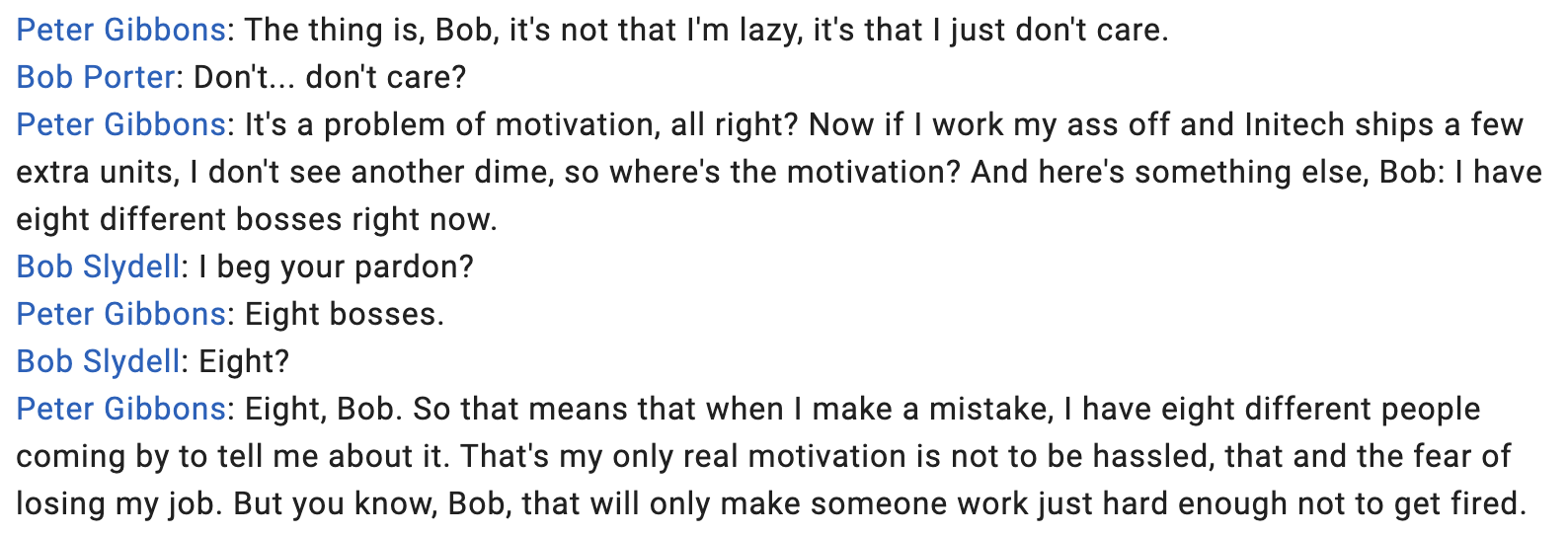
There's a great scene in the movie Office Space, which highlights this exactly. As part of an overall review of the company, "efficiency consultants" (Bob) asks Peter about what he does on a typical day:
So I'm not here to defend the over-inflated org chart. But flattening the organisation and getting rid of people is not the same thing as getting rid of bureaucracy.
Everyone is flattening
Gallup measures the average number of people reporting to a manager. In 2013 it was 8.2. By 2025 it was 12.1, close to a 50% jump, and most of that rise has come from cutting the layers in between.
- Citi went from 13 management layers to 8 under Jane Fraser.
- Amazon set a target to raise its ratio of individual contributors to managers.
- Google has said it cut about 35% of its small-team managers.
And the YouTube clip that made me think a bit broader for this article: Bill Anderson at Bayer has taken managers from around 16,000 to 4,500 with a model he calls dynamic shared ownership, thousands of small mission teams running in 90-day cycles with most decisions pushed to the people doing the work.
Some of this is overdue and Anderson makes an argument that does sound true:
you can't fix a hierarchy from inside a hierarchy, because the system itself is what's in control, not the people running it.
Rip out the layer whose main job was carrying messages up and down, and things move faster. Hard to argue with when you've lived the alternative.
The bit easily skips
Here's where I get uncomfortable and two things tend to be true when the cuts come, and both could get missed in the excitement.
The first is that you have to understand how the work underneath actually gets done before you remove the people doing it. A management layer is rarely just moving information around. It's absorbing load nobody wrote down, smoothing over the gaps between teams, catching the thing that would otherwise have become a problem. Cut the role without re-engineering the work, and that load doesn't vanish. It lands on the poor sucker who's left, usually without a conversation about it. I've seen restructures that looked clean on a slide and felt like chaos on the floor for at least the next six months.
The second is bigger. If you keep the same committees, the same audits, the same approval chains and decision matrices, and you simply take the people out, you haven't removed the bureaucracy at all. You've made it run with fewer hands. The process was the problem, not the headcount. This is why Anderson's line is "replace management with leadership", not "delete management". Bayer kept 4,500 managers. Their job just changed, from controlling the work to supporting the people doing it.
And there's a slower cost that only shows up later. The layer companies flatten first is usually the one that grows the next generation of leaders.
Stanford's Digital Economy Lab found that early-career workers, the 22 to 25 year olds, in the most AI-exposed jobs have seen a 16% relative drop in employment.
In the UK, the Institute of Student Employers reports that 87% of employers expect AI to reshape graduate and apprentice roles.
Automate the bottom rung and thin the middle, and you break the escalator people used to ride into leadership. It feels clever this quarter to hit a financial metric but the true cost will arrive in about five years.
What I think is really going on
I've always leaned towards servant leadership. The idea that a leader's job is to serve the people doing the work, to make sure they've got what they need to do it well, and a real sense of what we're all trying to achieve together. Admittedly, that could sound a bit soft next to the person who ran the tightest spreadsheet focusing on costs.
What's oddly reassuring is that AI might be the thing that finally makes it the practical option.
Because the admin was never the leadership. The admin was the tax on top of it. The status chasing, the reformatting of the same numbers so a different audience can read them. I remember needing to have one person, who's sole job was to create one powerpoint deck over the course of each month. It was soul destroying, repetitive and genuinely a waste of their talents.
And that's the part AI genuinely takes off your plate. McKinsey framed this well before the current wave, arguing the move is to eliminate the tasks that don't add value, the administrative and bureaucratic ones, but keep the role.
Josh Bersin makes a similar case now, that supervision becomes table stakes and the human work, coaching people and making the judgement calls a model can't, is where a manager earns their keep.
Even the boldest flatteners land here when you read the small print. Dorsey's radical three-role model at Block still keeps what he calls a player-coach, someone whose job is to build the capability of the people around them.
The machine can coordinate but it can't care why.
A recent paper from Stanford and INSEAD put it more sharply than I could: machines may learn to predict what we should do with real accuracy, but they won't care why, unless we deliberately build them to.
The UK and European voices I trust are saying the quiet part out loud. Ann Francke at the Chartered Management Institute:
"If we want AI to deliver real productivity gains, we need to focus on the people leading it, not the technology itself."
The CMI's own research found only 5% of managers reporting a real productivity gain from AI, and 38% saying they lack the training to make it work. Which tells me the constraint sits with the leadership around the tool, not the tool.
SAP's Christian Klein put it plainly too, that just buying a piece of AI and believing you've transformed the company is wrong, because then it never delivers the value you expected.

It depends on the shape you're in
One caution before anyone takes this as a formula. It isn't one.
A 50-person startup can be scrappy about all of this. Move people between projects on a Tuesday and change focus by Friday. The whole thing runs on trust and proximity, and the organisation is small enough to hold in your head. Good, that's an advantage, use it.
A larger organisation can't just copy that and hope. There's a change curve to walk people through, and real jobs and mortgages attached to every decision. Spotify's famous squad model is a useful warning here, one of the coaches who helped write it up later admitted they were never really doing it even as they described it, and it broke as the company scaled.
Copy the poster tag lines, skip the substance, and you get the friction without the speed.
The order is the same for everyone, though.
- Understand the work.
- Redesign it.
- Then decide the shape.
The pace is what changes with size, not the sequence.
So what?
I don't think this is the end of the manager. It's the end of the manager as a relay station, and if that was all that your managers were doing, then I'd largely say fair enough.
What's left is harder and more human: deciding what actually matters, and growing the people who'll end up deciding it too.
One of my podcast guests (Jenny Ainsworth - ps. she has a fabulous book Connection Intelligence that is genuinely worth any leader's time) said something that stuck with me when I raised the Block cuts. Her bet was that they'll end up recruiting a lot of that layer back, because they'll notice something fundamental has gone missing, and the real question nobody's asking is how you evolve as a leader once the tech is doing the message-passing for you. There's room for both, she said, and I think she's right.
So if you're looking at your own structure and wondering where AI lets you take a layer out, I'd only ask one thing before you do.
Can you say which tasks you actually removed, and which piece of leadership you deliberately kept and reinvested the freed-up time into? If you can answer that cleanly, you're flattening. If you can't, you might just be cutting.
Keen to hear how others are thinking about this.
♻️ Enjoy this? Repost to your network if you found this useful.
🔔 Follow Martin Wheatley more AI for leadership.
✅ 𝙃𝙚𝙡𝙥𝙞𝙣𝙜 𝙡𝙚𝙖𝙙𝙚𝙧𝙨 𝙗𝙚𝙘𝙤𝙢𝙚 𝘼𝙄-𝙘𝙤𝙣𝙛𝙞𝙙𝙚𝙣𝙩. Putting AI to work with your people, without replacing what makes them great.
⭐️ If that's the conversation you're interested in having, leave a comment, drop a DM, book a call, or visit my website. All links in my profile.
Sources
- From Hierarchy to Intelligence — Jack Dorsey & Roelof Botha, Sequoia, March 2026
- The CEO Who Got Rid of the Managers — Bill Anderson, Bayer, ARC 2026
- Span of Control: what's the optimal team size for managers? — Gallup, January 2026
- Jane Fraser cut Citi's management layers from 13 to 8 — Fortune, May 2026
- Andy Jassy on the manager-to-IC ratio — Amazon, September 2024
- Google has cut about a third of its managers — CNBC, August 2025
- Excess Management Is Costing the US $3 Trillion Per Year — Gary Hamel & Michele Zanini, HBR
- The vanishing, but vital, role of the middle manager — McKinsey
- The Rise of the Supermanager — Josh Bersin, September 2025
- Canaries in the Coal Mine: the employment effects of AI — Stanford Digital Economy Lab, November 2025
- Entry-level work reshaped, not replaced — Institute of Student Employers, May 2026
- Purpose not prediction: the role of managers in the age of AI — Goldberg (Stanford) & Puranam (INSEAD), April 2026
- Focus on the people leading AI, not the technology — Ann Francke, CMI, May 2026
- AI won't transform your company unless leadership changes first — Christian Klein, SAP, ESMT Berlin, April 2026
- Spotify's Failed #SquadGoals — Jeremiah Lee, 2020