

Martin Wheatley
Founder, The AI Leader Lab · CIMA Qualified · Managing Director, Rawson Ellis
Somewhere in the last year, "AI is destroying the planet" became one of those claims that gets a lot of airtime, politicised and weaponised.
I wanted to know if it was true. So, I took the International Energy Agency's report on energy and AI, and built a calculator that works out what a year of AI use actually costs in electricity and water, with every figure traced back to a page number.
What I found surprised me.
Start with you
A typical text prompt uses somewhere around 0.3 watt-hours, based on disclosures from Google, OpenAI and Microsoft collected in the IEA report. If your usage looks like a moderate professional's, say 25 chats a day plus a few reasoning tasks and the odd image, your entire year of AI comes to roughly 7 kWh.
That's 63 kettle boils. A year.
Even a proper power user, running agents daily and generating video, lands somewhere around 250 kWh a year. Still less than a tenth of what a typical UK home uses.
The viral claim that every prompt "drinks a bottle of water" turns out to be an accounting choice rather than a lie. The bottle version comes from studies that count everything: the cooling water, the water consumed at the power station generating the electricity, even the water used to manufacture the chips. The water used at the data centre itself is millilitres per query. Sam Altman puts it at about a fifteenth of a teaspoon, and while I'd treat any vendor's figure with caution, independent estimates of the on-site number sit in the same territory.
What does your usage look like....
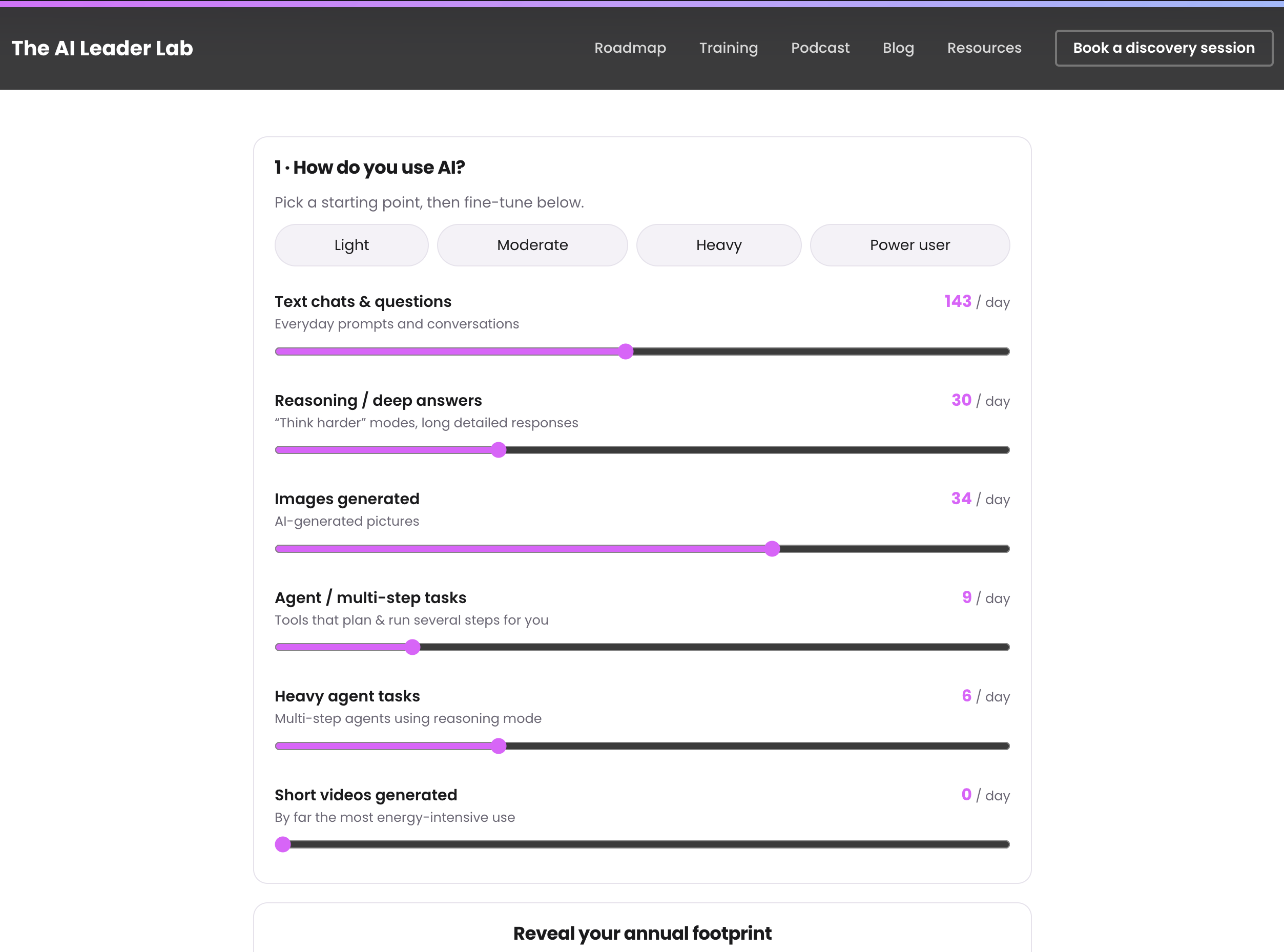
Find out your usage at https://www.theaileaderlab.com/ai-energy-calculator
Now zoom out
Data centres, all of them, your online banking and Netflix habit included, used about 1.5% of the world's electricity in 2024. The AI-focused portion of that is smaller still, under half a percent of global electricity today. And even by 2030, after more than tripling to around 465 TWh, AI data centres would be using about as much of the world's electricity as all data centres combined use right now.
The growth story is less dramatic than the coverage suggests too. The IEA expects total data centre demand to roughly double by 2030, to just under 3% of global electricity, and states plainly that this growth accounts for less than 10% of the increase in global electricity demand between now and then. Electric vehicles add more. So does air conditioning, and industry adds far more than either.
Nobody is marching against air conditioning.
Where the concerns are real
I don't want to pretend it's all noise, because it isn't. If a data centre lands near your home, the construction and the hum and the pressure on local infrastructure are legitimate complaints. And there are places where the numbers are genuinely not pleasant. Google's data centres in The Dalles, Oregon, a town of 16,000 people, used 355 million gallons in 2021, roughly a quarter of the city's entire water supply. More than 50 US cities have now put bans or moratoria on new data centre construction.
The UK deserves an honest look as well…
Our data centres crowd one corner of the grid, with 1.7 of the country's 2.4 GW sitting within 20 miles of London, and 140 proposed sites are asking for around 50 GW of grid connections, more than the entire country's peak demand. Projections in the latest Electric Insights report see data centres reaching 8 to 16% of Britain's electricity within a decade. That's a genuine planning and infrastructure question which deserves a genuine answer, without being proof that the technology itself is rotten.
One number, two different conversations.
The water bit I got wrong
I'd assumed most data centres run closed-loop cooling. Sealed systems, same water going round and round, nothing drawn from the local supply. Turns out that's only partly right.
Closed-loop designs exist, they reuse the same water over and over and can cut freshwater use by up to 70%, and they're increasingly the standard for new AI facilities. But most of the installed base uses evaporative cooling, where roughly 80% of the water withdrawn simply evaporates, often drawn straight from the municipal supply.
Why? Because evaporation saves electricity. There's a real trade-off buried in there, and it's the sort of thing that never makes the headlines: use less water and you'll burn more power, use less power and you'll evaporate more water. An engineering choice to be made on a site by site basis rather than a scandal.
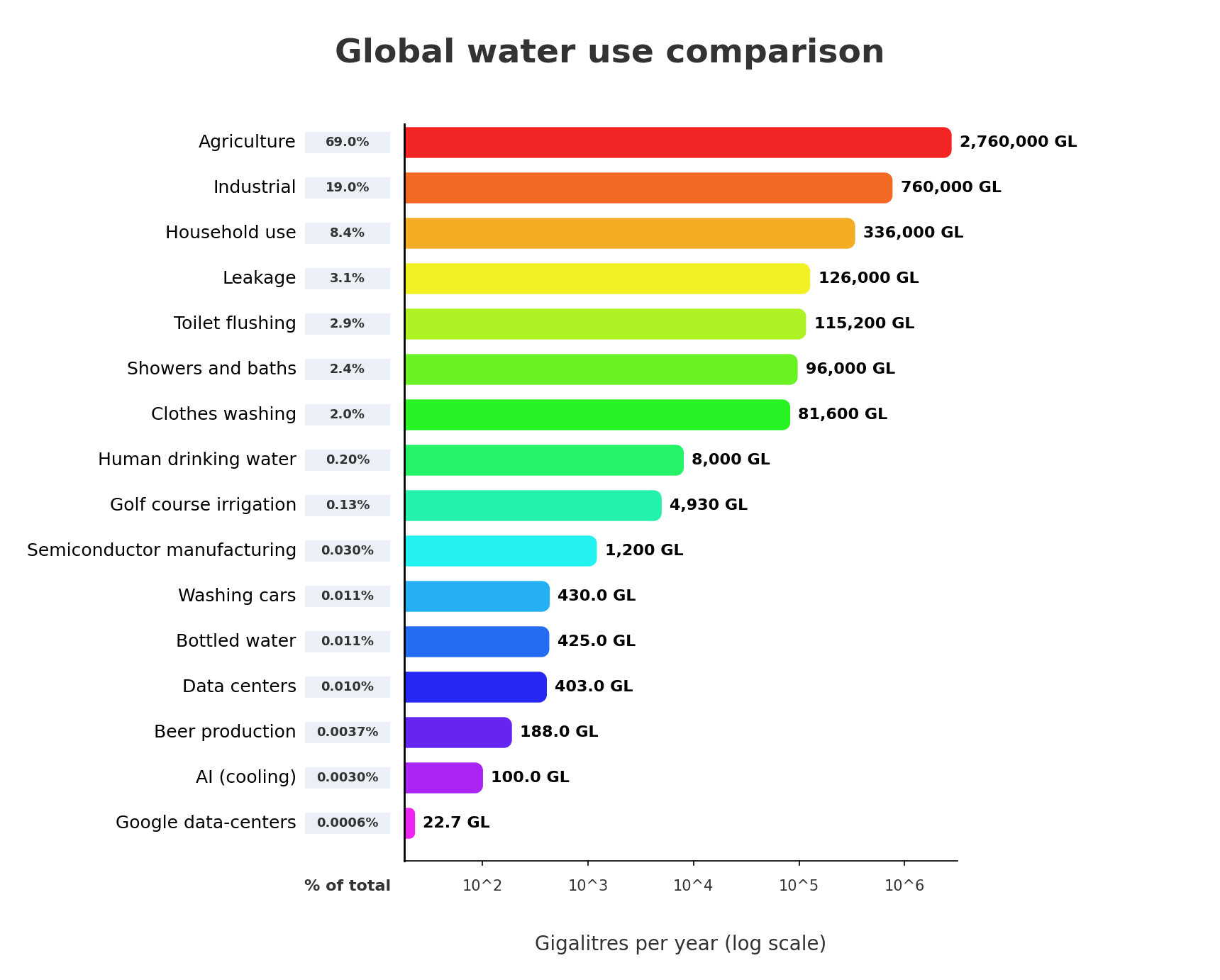
For scale: agriculture takes about 70% of the world's water withdrawals. Golf courses alone account for something like half a percent of US water use. Data centres are a rounding error at global level and occasionally a real problem at postcode level.
Both things are true at once, which is precisely why the shouting match is so unhelpful.
The caveat
The strongest criticism of everything above isn't that the numbers are wrong. It's that too many of them start life inside the companies being measured. Researchers led by Sasha Luccioni have shown that environmental transparency from AI firms has gone backwards since 2022, and a 2026 paper in AGU Advances makes the same case for water reporting.
They're right and it's why I anchored the calculator to the IEA rather than to vendor blogs, and why it labels water and carbon as derived estimates instead of presenting them as facts.
What I'm taking from this
My personal AI guilt wasn't built on any real numbers and I hadn't done the maths until now. I suspect most of the confident commentary in both directions is also like this. The argument has been politicised into a simple good-versus-bad fight, and the numbers just don't seem to carry that story.
The useful questions turn out to be boring ones about siting, cooling design, grid queues and water permits. "Is AI bad for the planet" is too blunt an instrument to produce a useful answer.
And inside a business, the same discipline applies at a different altitude. A guest on The Frontier Leader Show put it in a straightforward way: AI is not needed all the time.
The waste worth worrying about was never your chat history. It's the AI projects that shouldn't exist in the first place.
If you'd like your own number, the calculator is live on theaileaderlab.com shortly. It takes about a minute, and it will show you exactly where every figure comes from.
♻️ Enjoy this? Repost to your network if you found this useful.
🔔 Follow Martin Wheatley more AI for leadership.
✅ 𝙃𝙚𝙡𝙥𝙞𝙣𝙜 𝙡𝙚𝙖𝙙𝙚𝙧𝙨 𝙗𝙚𝙘𝙤𝙢𝙚 𝘼𝙄-𝙘𝙤𝙣𝙛𝙞𝙙𝙚𝙣𝙩. Putting AI to work with your people, without replacing what makes them great.
⭐️ If that's the conversation you're interested in having, leave a comment, drop a DM, book a call, or visit my website. All links in my profile.
Main Sources:
IEA report - https://www.iea.org/reports/key-questions-on-energy-and-ai
UK concentration of energy: https://reports.electricinsights.co.uk/?p=2687