
Martin Wheatley
Founder, The AI Leader Lab · CIMA Qualified · Managing Director, Rawson Ellis
Two of the loudest voices in AI spent the last year telling us that white-collar work was about to be annihilated. This month, Sam Altman said he'd been "pretty wrong" about that. And while the headlines caught up with the climbdown, a wholesale retailer that still sells a hot dog for £1.50 had quietly been doing the thing I've argued for all along.
The default corporate instinct with AI is to treat it as a cost lever. Find the tasks, remove the people, report the saving. I understand the pull of it; when a tool can do in seconds what used to take a person a whole afternoon, the spreadsheet maths is obvious, and boards, investors and CFOs like obvious.
The cutting is real, too. Tech layoffs have been in the news all year so far and have passed 115,000 by May 2026, with Oracle, Meta and Amazon among those naming AI as a driver.
But cutting has a floor and you run out of things to remove. Somewhere on the way down, you start removing the capability and culture that made customers choose you in the first place.
There's a quieter group I find more interesting, though. The leaders who don't want to cut at all. They love what they've built and they're ambitious for it. They can see AI lifting their people rather than thinning them out. They just have no idea where to start; the blank page, not the layoffs, is what's holding them back.
The Costco version
Costco has rolled AI into its pharmacies and gas stations, and across accounting and IT. More than 341,000 people are on the payroll. And the company's president, Ron Vachris, told the Economic Club of Chicago this month that none of it has cost jobs. "We've not displaced people because the business is growing at a faster rate," he said.
The people who used to do those tasks have moved into more forward-thinking roles.
That's the part worth slowing down on.
Costco hasn't dragged its feet on the technology. It has pointed it at a different goal: lifting people into work they weren't doing before, while the business grows fast enough to absorb them. Vachris was clear he doesn't see AI taking buying decisions out of the hands of a skilled buyer. The tool sharpens the people. It doesn't stand in for them.
Where most companies actually sit
The way I think about this is through what I call the AI Maths Framework. Most businesses I come across are doing one of two things.
Some are in Subtraction. They've stripped the low-value tasks off people's plates, which feels like progress, but the work itself hasn't really changed and the roles quietly start to feel thinner. Others are in Addition. They've bought the tools, some people are using them, training may be sparse, and the operating model underneath is exactly what it always was. AI sits as a layer on top rather than a change in what the organisation can actually do.
Multiplication is the one almost nobody seems to be reaching. It's when AI lets people do work they genuinely couldn't do before. Different work, not the same work faster. Costco's "elevated into forward-thinking roles" is a glimpse of it.
The questions give them away. Subtraction and Addition both ask a version of "how do we get AI into the business." Multiplication asks something harder and more useful:
what could our people do that they can't do today, if AI were introduced in the right way?
That question sounds enormous, and the leaders who care most are often the ones who freeze on it. The honest answer is that the first move is almost always smaller and more specific than the ambition behind it. You don't start by transforming the company, you start by finding one place where your people are capped by something AI could lift, and you prove it there. The ambition is the easy part, the starting point is the bit that actually needs working out.
The climbdown, and the timing
Which brings me back to Altman and Dario Amodei. A year ago, Altman was warning that entry-level roles were at serious risk. Amodei went further and suggested AI could wipe out half of all white-collar jobs. Both have now softened considerably. Altman says the displacement he feared simply hasn't shown up, and Amodei has reframed automation as a multiplier rather than a destroyer, predicting the slice of work left to people "expands to be 100% of what people do."
Amodei must have liked my Multiply Method...
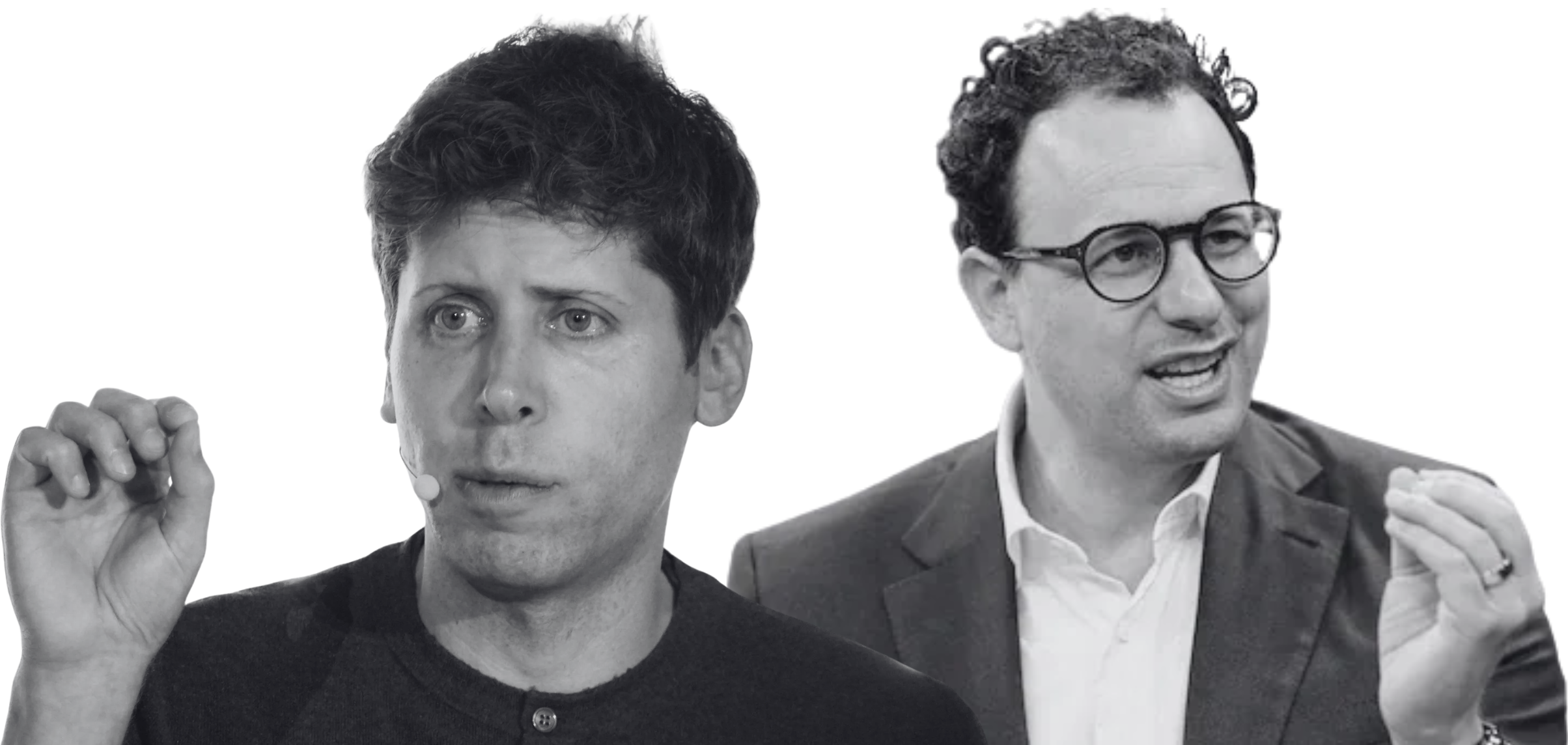
The detail behind Altman's change of heart interests me more than the headline. He tried handing his email and Slack over to AI, then went back to answering them himself, because he cares about the interactions with the people on the other end. I get that completely. I love this technology AND I still want to deal with people.
It would be naive not to notice the timing, though. Both OpenAI and Anthropic are reported to be heading for IPOs at around a trillion dollars each. "AI will take your job" is a hard thing to sell to investors who want a business society is glad to have. "AI will help people do more" is a far easier one. I'm not questioning whether they believe it. I'm noting that the narrative and the fundraising have started pointing in the same direction.
Why the ceiling is higher than the panic suggests
There's an old idea from the economist Robert Solow that fits here. When computers were spreading through offices, he pointed out that you could see the computer age everywhere except in the productivity figures. The technology ran well ahead of what organisations were actually getting out of it, because adoption and the slow work of reorganising around a tool lag a long way behind the tool itself.
The Fortune piece reaches for a related idea, Jevons' paradox, where making something cheaper tends to mean we use more of it rather than less. Same direction of travel.
David Solomon at Goldman Sachs makes the long-range version of the same case, and unlike Altman and Amodei he never held the apocalyptic view to begin with. He points to a century of American history, civilian employment up around 145% since 1962, and draws a straight line from the electrification of the early 1900s through to the digital revolution, then asks why the pattern would break this time. His line is a good one:
do any of us feel like we have less to do since email and Excel arrived?
That lag is still the real story. Most organisations are nowhere near the ceiling of what they've already bought, never mind what's coming. The constraint was never really the technology, it's how slowly we rewire the work around it.
What's actually being decided
Cutting and building are two different bets on what a company is for. The cut case treats people as a cost to be reduced. The build case treats them as the thing the technology makes more capable. Both have a genuine argument, and there are roles AI will make redundant, so pretending otherwise helps no one.
The long-term vision is the thing I'd protect. Whatever made a company good in the first place, and it's usually the people, is a strange thing to optimise away in pursuit of a quarterly number. Costco didn't build a base of more than 81 million members, with over half its US staff there longer than five years and some 23,000 past the twenty-five-year mark, by being the cheapest operation to run. It got there by being worth choosing.
A sceptical CFO will push back here, and fairly. Costco is a structurally growing retailer, so "we grow faster than we automate" comes easier to them than to a mature business with flat revenue. Fair point. Growth isn't the claim I'm making, though. What decides the outcome is where you aim the tool, whether it compounds your people's capability or quietly hollows the roles out.
So the real question isn't whether to use AI. It's what you point it at. Cutting has a limit you'll hit sooner than you think. Building doesn't seem to have one yet.
What would your people do, if you built rather than cut?
And if you already know the answer to that, and you're just stuck on the first step, you're in better company than you'd think. That gap between wanting to build and knowing where to begin is the conversation I have most weeks, and the one I enjoy most. Happy to be a sounding board for where yours might start.
Sources:
Ron Vachris at the Economic Club of Chicago, via Yahoo Finance / Geekspin. https://finance.yahoo.com/sectors/technology/articles/costco-won-t-let-ai-130040540.html
Sam Altman and Dario Amodei comments via Fortune, 26 May 2026. https://fortune.com/2026/05/26/sam-altman-dario-amodei-walking-back-ai-jobs-apocalypse-prophecies-ipo/