
Martin Wheatley
Founder, The AI Leader Lab · CIMA Qualified · Managing Director, Rawson Ellis
In Catch Me If You Can, Tom Hanks spends most of the film one step behind Leonardo DiCaprio. He's diligent and he's capable but he's just always arriving that split second too late.
I thought about that film when I read the latest figures from the Office for National Statistics (ONS). *Ok, I didn't but Claude made it sound like a plausible link and I love a good movie reference.*
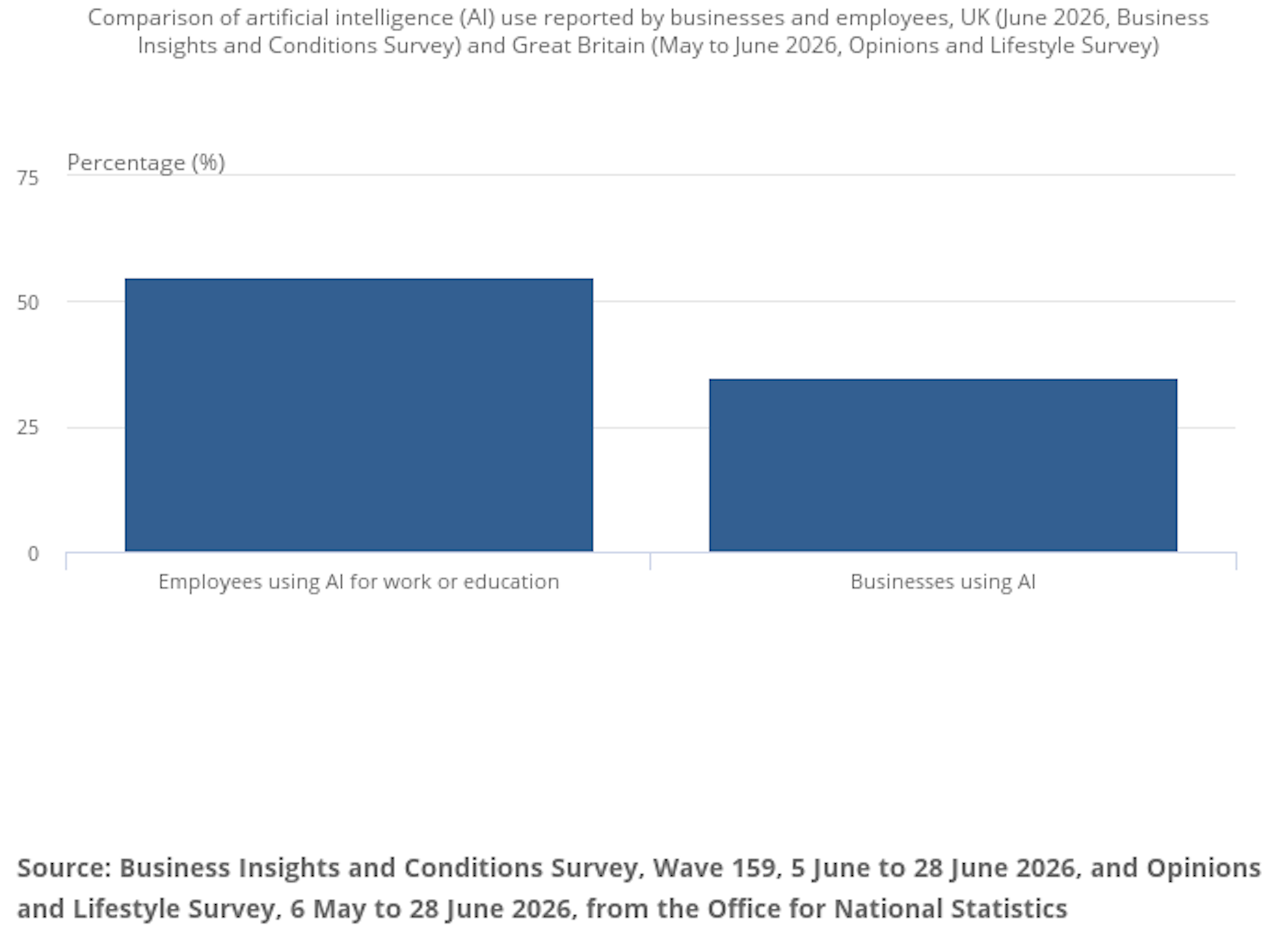
More than half of workers now say they use AI for work or study. Only around a third of businesses with ten or more staff say they use it at all (ONS, July 2026).
So in a lot of organisations, the people are already out ahead and the business is the one doing the chasing. This may also reinforces the struggle firms are having with "shadow AI", where people are using unapproved AI tools for work purposes.
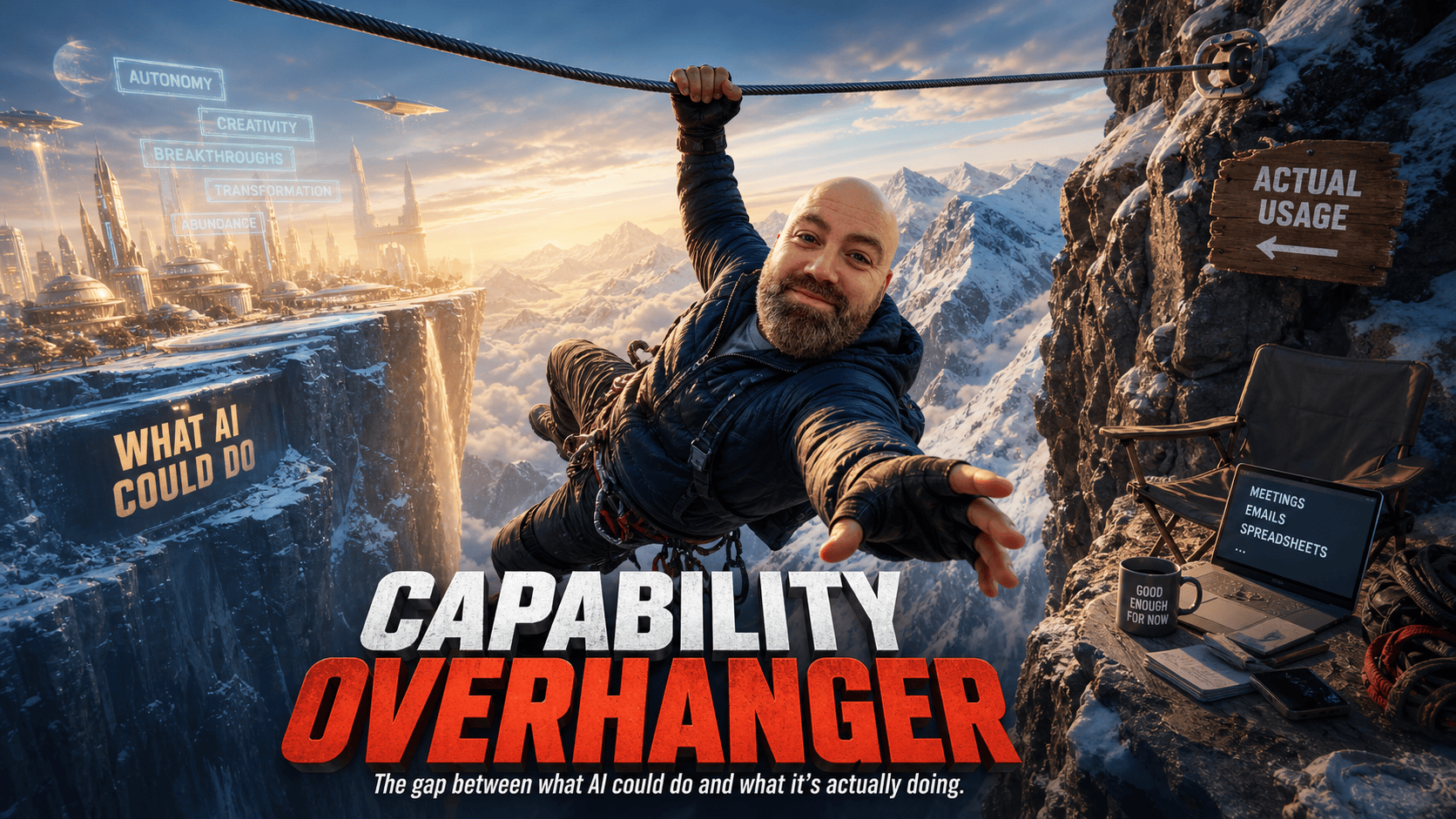
I don't read that as a technology problem, but more of a leadership and teamwork problem, and that's what this piece is about. I'll set out where UK businesses actually are, then share what some of the guests on my podcast, The Frontier Leader Show, have told me about closing the gap.
Where UK businesses are right now
Seven in ten UK businesses still don't report using any AI at all. That's the headline from the ONS Business Insights and Conditions Survey, published on 8 October 2026 and based on responses from almost 10,000 firms in late September (ONS, October 2026).
The direction is clear enough. When the ONS first asked the question in September 2023, only 9% of businesses said yes. For firms with 250 or more staff, adoption has gone from 19% to 51% in three years.
Two things stood out to me, though:
- First, the overall figure barely moved between June and September this year.
- Second, even among the largest firms, roughly half still don't report using AI.
If you run a business of a few hundred people and feel you haven't really started, you're in very large company.
Note: The survey doesn't cover finance and insurance, and the ONS labels the results official statistics in development. They're the best official measure we have, but they're a guide rather than gospel.
Wide, but not very deep
The more interesting story sits underneath the adoption figure. In July the ONS published a deeper look at how businesses with ten or more staff actually use AI (ONS, July 2026).
- Only 10% of businesses using AI say they use it extensively.
- The average adopter uses 1.6 types of AI technology, up from 1.4 in late 2023. The ONS's own reading is that this implies limited transformation so far.
- In 15% of businesses, more than half of staff use AI in their daily work.
- Only 11% say more than half their workforce has had any AI-related training.
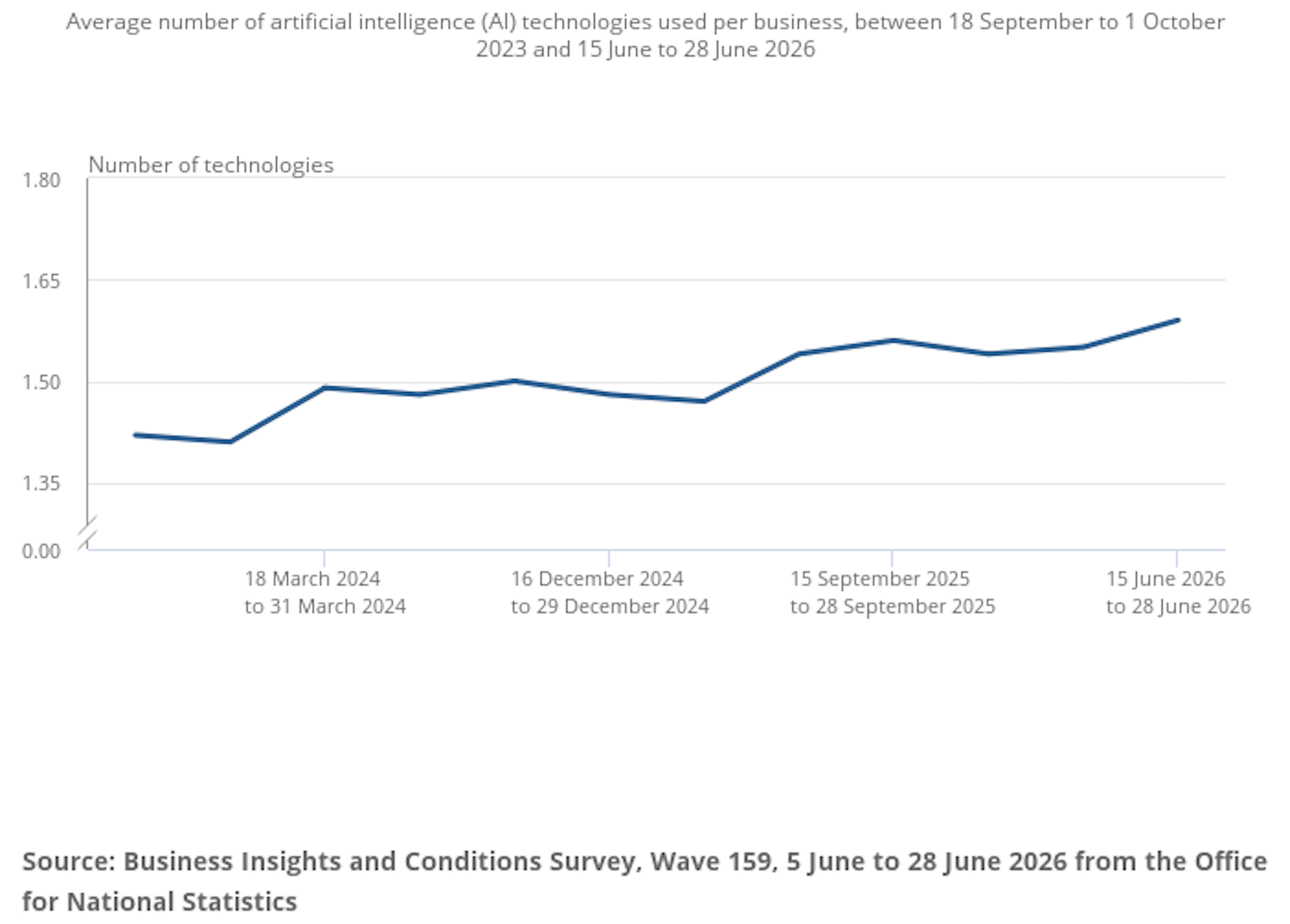
Put simply, a lot of businesses have bought a licence or allowed a free tool, and stopped there. The most common uses are writing text with tools like ChatGPT or Microsoft Copilot, and creating images.
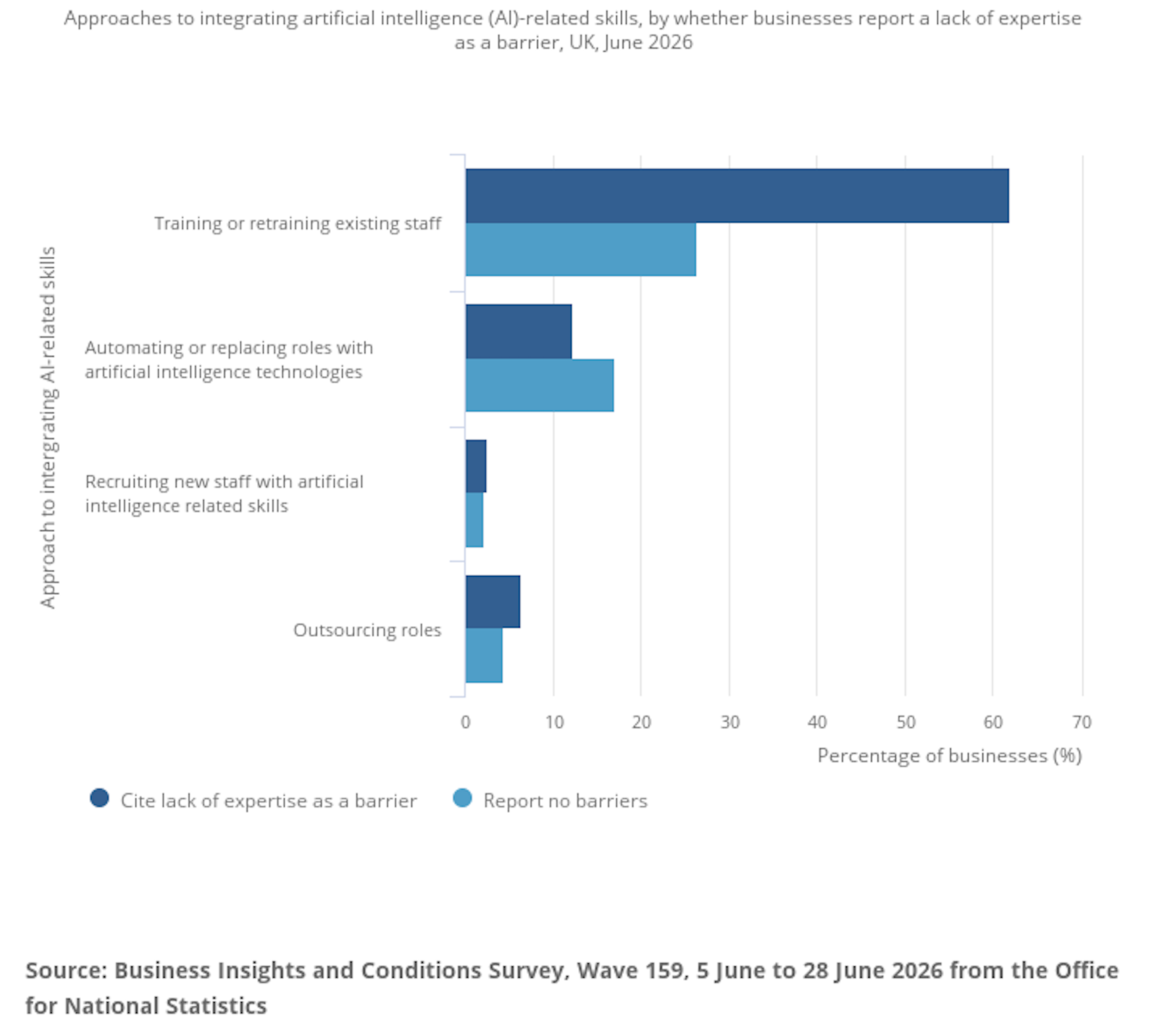
The barriers businesses report are revealing too. The ONS's earlier work found the most common were struggling to identify where AI would help, cost, and a lack of expertise. Among firms that do invest, training existing staff is by far the most common response. Of businesses that cited a lack of expertise, around 62% were training or retraining their people.
The jobs picture is calmer and reassuring than the media headlines suggest. Of businesses with ten or more staff using AI, 6% say it has reduced headcount (ONS, October 2026). What's changing is the work inside roles, with administrative and clerical jobs the most affected.
Learning it together
When I set those numbers alongside my podcast conversations, one theme keeps surfacing. The businesses making progress treat AI as something a team learns together, rather than a tool that gets switched on.
Steve Rowbotham won Olympic bronze for Team GB and more than 30 world medals across 11 years of international rowing. He now runs Navigator, a travel data business he founded. Rowing taught him to work backwards from a clear outcome, breaking the goal of Olympic gold into yearly and daily steps.
He brings the same thinking to AI. His advice was to start at whatever level you're comfortable with, and to accept that nobody has this fully worked out yet. At Navigator, people are encouraged to use AI widely within clear data-security rules. When a team takes something on, he gives them one focused use case, such as using AI inside Excel, gets it working, then decides the next step together.
What struck me most was how he described his move from sport to business. As an athlete, the focus was on himself. As a CEO, it's on other people, and he finds that more rewarding. That shift from "my performance" to "our performance" is exactly what AI adoption asks of a leadership team.
Jim Spignardo is Director of Cloud Strategy and AI Enablement at ProArch, a global IT services firm of around 400 people. He resisted the temptation to buy licences for everyone and hope for the best. He set some clear boundaries first, then picked one live business process and ran AI alongside the existing way of doing it, comparing the two directly.
Rather than licensing the whole firm, he started with a small group of willing early adopters. The value ProArch attributes to Microsoft Copilot grew from a few thousand dollars a month to around $75,000 a month, with 160 of those 400 staff now licensed. Jim was also clear that someone in the business has to own AI adoption, and he expects most organisations to have someone with AI in their job title within a year.
Two other conversations add something here. Amanda Daering, a workforce adviser who built and sold the recruitment consultancy Newance, argues that the workflow is replacing the job as the basic unit of work. That changes the conversation from "which roles does AI affect?" to "which pieces of work could this team do differently?"
Jenny Ainsworth, author of Connection Intelligence, warns about what gets lost when businesses strip out the people who hold teams together. Her question is how leaders evolve once technology handles more of the message-passing.
Put those together and you get a fairly consistent picture...
Progress comes from small, shared experiments, with someone accountable for them and leaders learning alongside their people.
Something to try in your next leadership meeting
None of this needs a big programme. These are the questions I'd put on the agenda, and the ones I'd want to be asked myself.
- Find out what your people are already doing. Ask each manager to come back with two or three examples of how their team uses AI today, including the free tools nobody signed off. If the ONS figures hold for your business, the answer will be more than you expect.
- Pick one piece of work, not one tool. Following Jim's approach, choose a single live process, such as month-end reporting or drafting client proposals. Run AI alongside the current method for a month and compare the results.
- Give it to a small, willing group. Five people who want to try it will teach you more than fifty licences handed out to people who don't.
- Name an owner. It doesn't need a new title. It needs one person with the time and authority to keep it moving, and a seat at the table when it's discussed.
- Go first. Steve's point about focusing on others cuts both ways. A leadership team that is visibly learning, and visibly getting things wrong, gives everyone else permission to do the same.
Given that only 11% of businesses have trained more than half their staff, even a modest, regular habit of learning together would put you ahead of most.
Closing the gap
In the film, the chase only ends when the two of them stop competing and start working together. I'm not sure the AI version is very different.
Your people have already started. The question I'm working through with the leaders I talk to is a simple one: how do we turn that scattered, individual experimenting into something the whole team learns from?
I'd be interested to hear how you're approaching it. What's the one piece of work in your business you'd try first?
And if you're thinking about where to get started with AI, I'd be interested in working with you.
♻️ Enjoy this? Repost to your network if you found this useful.
🔔 Follow Martin Wheatley for more AI for leadership.
✅ 𝙃𝙚𝙡𝙥𝙞𝙣𝙜 𝙡𝙚𝙖𝙙𝙚𝙧𝙨 𝙗𝙚𝙘𝙤𝙢𝙚 𝘼𝙄-𝙘𝙤𝙣𝙛𝙞𝙙𝙚𝙣𝙩. Putting AI to work with your people, without replacing what makes them great.
Sources
Official statistics
- Office for National Statistics, Business insights and impact on the UK economy: 8 October 2026. AI adoption by business size, September 2026, plus roles and headcount effects.
- Office for National Statistics, Artificial intelligence in UK businesses: 2023 to 2026 (20 July 2026). Depth of use, training, barriers, and employee versus business use.
- Office for National Statistics, Management practices and the adoption of technology and artificial intelligence in UK firms: 2023. Earlier analysis of barriers to adoption.
The Frontier Leader Show (all episodes)
- "Four Years to Four Minutes: Leading at AI Speed, with Steve Rowbotham".
- "Every Company Needs Someone With AI in Their Job Title, with Jim Spignardo".
- "How AI Is Quietly Reclassifying Work, with Amanda Daering".
- "Connection Intelligence: Leading Across Generations and AI, with Jenny Ainsworth."