
Martin Wheatley
Founder, The AI Leader Lab · CIMA Qualified · Managing Director, Rawson Ellis
I can usually guess how an AI rollout will go before anyone touches a tool. Not from the budget but from the questions the leader asks first.
Most of the senior leaders I talk to have handed AI to someone. IT, usually. Sometimes a task force, sometimes the keen head of ops who put their hand up. The brief tends to be a version of "get people using this stuff."
Fast forward six months, the licences are bought, a few people are pasting things into ChatGPT or Microsoft Copilot, but the business looks more or less identical to how it looked before. The leader knows that something's off, but they just can't name it, and they can't talk about AI with the authority they're used to having in every other part of the business.
I recorded an episode of the The Frontier Leader Show recently with Mark Schaefer , who's written twelve books, his most recent being "How AI Changes Your Customers". One line struck a chord with me.
He said:
a leader today can't have all the right answers, but they can have the right questions.
Then the follow up like a decent movie sequel:
and you can't have the right questions about AI unless you know what's possible.
That's the whole thing, really.
Because the questions a leader reaches for isn't random, it comes straight from the position they're looking from.
Over the last couple of years I've ended up mapping four themes of them, and the questions turn out to be the fastest read I've got on where a business is actually starting from. I call it the AI Maths Framework.
- A business in Division asks: where can we cut? AI shows up as cost pressure and the threat of fewer people. This is the one I'm openly against, and I'll come back to why.
- A business in Subtraction asks: what can we take off people's plates? Useful enough. But the work itself doesn't change, and roles just get thinner without anyone deciding what the freed-up time is for.
- A business in Addition asks: how do we get people using AI? Tools go in on top of the same old workflow. This, or Subtraction just behind it, is where most of the 50 to 1,000 person businesses I see are starting from.
- A business heading for Multiplication asks something different: what could our people do that they can't do today, if AI were brought in the right way?
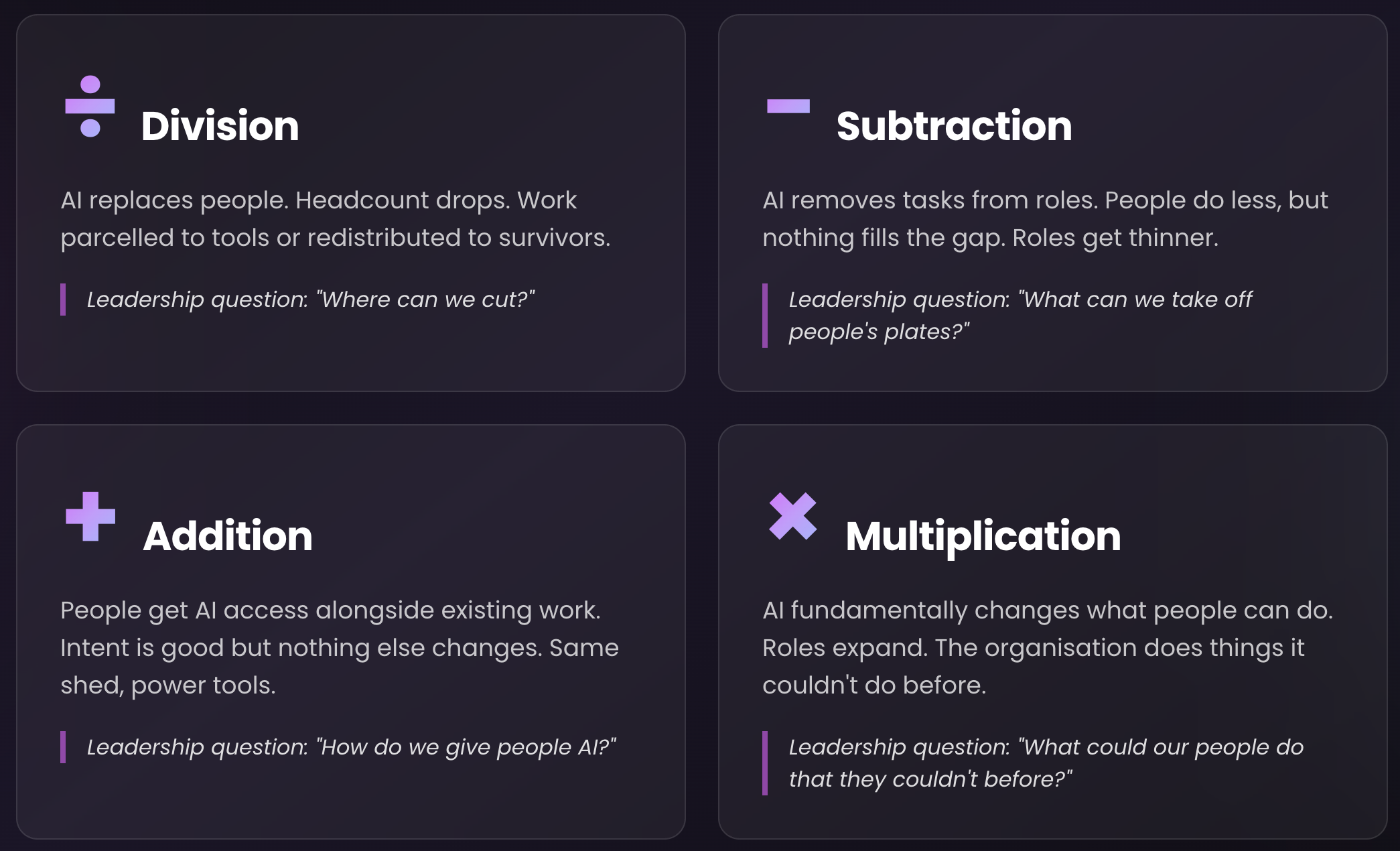
These aren't four rungs of a ladder, though. Nobody climbs from one to the next in order. They're four different places a business can be standing when AI arrives, and three of them go nowhere if you stay put.
Multiplication is the only one that actually leads anywhere.
The leader who's never properly used the tools almost always lands on one of the first three. Not because they're not sharp, but because, like Schaefer said, you can't ask "what could my people do that they can't today" if you've no felt sense of what these things can do. The imagination isn't there yet and so the question shrinks to fit what they can see, which is usually cost, or admin at best.
The leader becomes the ceiling. Quietly, without meaning to.
A few things worth noticing, rather than a to-do list
- The question you reach for first is worth catching yourself on. It's a fairly honest read on where you're standing, before any strategy deck gets written.
- Going hands-on isn't a junior task to hand down. It's the thing that changes which questions you're even capable of asking.
- "Where can we cut" feels like the responsible, hard-nosed, financially-based ROI question to ask. In my experience it's usually the smallest one in the room.
- If the work looks the same six months after the tools landed, the rollout probably answered "how do we get people using it" and stopped there.
Schaefer made another great point in that as AI spreads, plain humanity might end up being the luxury good. The business that still has a person who picks up the phone and actually knows the client by name, that might be the difference nobody can copy.
Which is why the cutting question worries me most. It strips out the very people who made a company great and worth dealing with in the first place. To my mind the point of bringing AI in is to make the people who built a business bigger, not to quietly clear them out.
That's the gap between AI happening to your business and you having a hand on the steering wheel.
Nvidia's Jensen Huang, recently criticised business leaders blaming AI for layoffs as "lazy" and I'd echo that . This technology will transform every part of our lives, so the better questions should be around building what we want for tomorrow, with the people that make us great today.
So the thing I'd leave you with is a question about your questions. When AI first landed on your desk, what's the one question you reached for? And is it the biggest one you could have asked?
If you want a structured way to work that out, the AI Maths Framework is the diagnostic I use to find a business's real starting point.
Be a Multiplier.
M.
Enjoy this? ♻️ Repost it to your network and follow Martin Wheatley for more.
✅ Helping leaders become AI-confident. Putting AI to work with your people, without replacing what makes them great.
🧭 Get your copy of the Multiply Method. It's a FREE roadmap walking you through how to multiply the capabilities of your people and your business with AI.
🗣️ If that's the conversation you want to have, book a call here.
📍 Or visit: www.theaileaderlab.com
Sources:
Jensen Huang Video - https://www.youtube.com/shorts/tDQcQv6M5e4