
Martin Wheatley
Founder, The AI Leader Lab · CIMA Qualified · Managing Director, Rawson Ellis
Why the AI model you pick matters more than most SME leaders think. And why Fable, Opus and Sonnet are Lewis Hamilton fans.
You wouldn't ask your finance director to do the morning post run. They'd do it perfectly well of course (or you'd hope they would), but it would just cost you an hour of the most expensive time in the building, and the letters wouldn't arrive any faster.
And similarly on the flip side, hand the quarter-end forecast to whoever usually delivers the post, and you'll probably get something completely gibberish in return.
A lot of businesses using AI are making one of these mistakes every day without realising it.
Every business has its usual suspects: the people work gets handed to out of habit rather than because they're the right fit for the job. Most businesses now have a usual suspect for AI too and it's often whichever model was selected last time.
Anthropic, the company behind Claude, doesn't just offer one Claude, it offers four, (or five if you include Mythos). Each built for a different kind of work and each priced differently. Choosing between them is now a real business decision, and it sits closer to staffing than to IT.
And this could easily translate across to ChatGPT with their Astra, Sol, Terra and Luna models.
Four models, four kinds of colleague
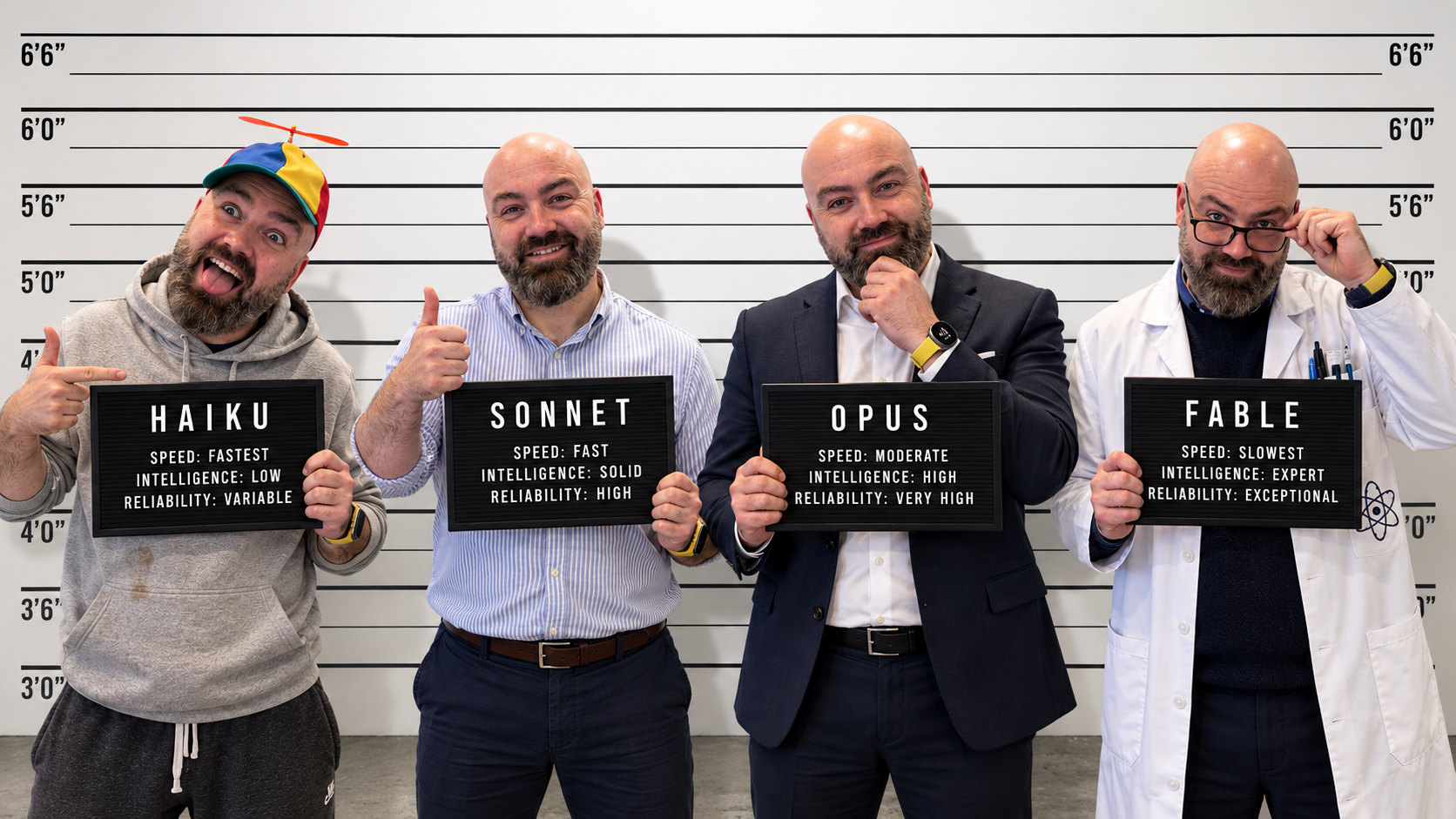
The simplest way I've found to explain the range is to picture four people on your team.
Haiku is the quick, reliable administrator. It's built for everyday requests: quick answers, simple summaries, pulling a fact out of a document. It's the fastest and cheapest of the four.
Sonnet is the capable all-rounder. Anthropic calls it the daily driver for writing, analysis and most problem-solving, and advises starting with it if you aren't sure which to pick.
Opus is the specialist you think alongside. Anthropic positions it for deep analysis you'll question, redirect and build on as you go. Picture a senior adviser in the room with you, working through a problem together.
Fable is the senior person you hand a whole project to. It's Anthropic's most capable model. You describe the outcome you want, and it plans the steps and checks its own work along the way. The trade-off is that it's slower and uses the most of your allowance.
In fact, Anthropic put a recent post out as well to support this:
Why the choice costs real money
On paper, the price gap is wide. Fable is billed at $10 per million "tokens" going in and $50 per million coming out, against Haiku's $1 and $5.
A token is Anthropic's (and all similar AI LLM providers') billing unit, roughly three-quarters of a word. So the most powerful model costs ten times the cheapest for the same volume of text.
If your team is on a Claude business plan rather than paying per use, the cost shows up as allowance instead of invoices. Anthropic itself warns that using a heavy model on a task a light one could handle wastes your allowance and slows you down.
But the price list only tells you the cost of each token. It doesn't tell you the cost of a finished job, and it doesn't tell you the cost of a wrong answer. I wanted to do a test to find out both.
What happened when I gave four models the same question
So I lined up four suspects, gave them the same question, and checked every answer.
I picked a subject where I could check the answers: Formula One. I gave all four models the same set of files from Kaggle, covering the complete F1 data set from 1950 to 2026, which included every one of Lewis Hamilton's races with every lap time and result. The question I wanted answering was: "How much of Lewis Hamilton's success is down to Hamilton, and how much is down to the cars he drove? And what does the data say about how his performance has changed over his career, including his move to Ferrari?"
The full prompt is here:
The folder attached contains a complete Formula 1 dataset from 1950 to the present (circuits, constructors, drivers, race results, lap times, pit stops, qualifying, standings, sprint results, seasons and status codes). Use it to answer the following question as rigorously as you can.

THE QUESTION: How much of Lewis Hamilton's success is down to Hamilton, and how much is down to the cars he drove? And what does the data say about how his performance has changed over his career, including his move to Ferrari?

HOW TO APPROACH IT: The only like-for-like comparison in F1 is a driver against his teammate in the same car. Build your analysis around that, but decide for yourself which measures are fair (e.g. qualifying, race finishes, points, race pace, recovery from grid position) and justify your choices.

Examine the data before analysing it. Tell me what coverage gaps, inconsistencies or traps you found, and how you handled each one.

Separate what the data shows from what you are inferring. Where a conclusion depends on a judgement call, say so.

WHAT I WANT BACK
1. A one-paragraph answer to the question, written for an intelligent non-expert.
2. A season-by-season view of Hamilton against each teammate, with the measures you chose.
3. Three to five findings that a casual fan would not already know, each backed by specific numbers.
4. The strongest counter-argument to your own conclusion, and why you do or don't accept it.
5. A clear verdict with a confidence level (high / medium / low), plus what additional data would change your mind.
6. A short note on your method: the files and joins you used, and any assumptions. Show your working with numbers. Accuracy and sound reasoning matter more than length.

Do not change any files within the folder.
Note: I didn't ask it for an opinion on Hamilton being robbed of an eighth world title in 2021, although I'm sure it would have said that Red Bull and Verstappen were dirty cheats.
Dirty cheating Red Bull aside, each model ran as a full working session. It read the files, wrote its own code to analyse them, and produced a verdict. All four had access to exactly the same data and were all given the exact same prompt.
Here's what it cost and how long it took:
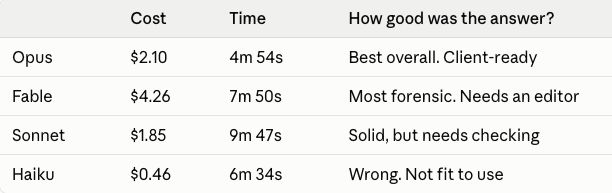
The most expensive run cost about the price of a coffee.
Fable and Opus worked separately and landed on almost identical numbers, often to the decimal point. Both also found problems hidden in the data. Fable noticed that the way the files joined together would drop the two most recent seasons. Opus noticed that the newest data recorded every retirement the same way, so a gearbox failure and a driver error looked identical.
Where the two differed was in how they wrote. Fable wrote like an analyst briefing another analyst: dense, meticulous, and careful to label where it was guessing. Opus wrote like an adviser briefing a board. It turned percentages into seconds per lap and gave a separate confidence level for each claim. Opus's is the one I could operationally rely on with minimal editing.
FABLE Verdict and confidence

- Car: necessary and dominant in the raw totals. His team's share of all championship points ranged from 11% (2009) to 37% (2015), a 3.3× swing; his premium over a strong teammate was a steady 1.1–1.2×. The car explains why the wins came in 2014–21; the driver explains why 106 rather than roughly 50. High confidence.

- Trajectory: at or near the top of the field relative to teammates through 2021; roughly level with Russell 2022–23; clear one-lap decline from 2024; comprehensively beaten in 2025; back to parity with Leclerc in 2026 on a partial season, with a soft second quarter. Medium confidence on 2026 (n=14, and 2026 is a rules reset that reshuffles everything).

- What would change my mind: fuel- and tyre-corrected lap times (to separate pace from strategy); upgrade allocation and strategy-call records by driver; sector times and practice data; the remaining nine races of 2026; and any evidence of team orders or a designated No. 1 in 2025 Ferrari. A different set of teammate strengths would also move the size, not the direction, of the premium.
OPUS Verdict and confidence
The car decided how many wins Hamilton could fight for. Hamilton decided how many of those he took.
- Hamilton is an elite driver, and his car was the multiplier: high confidence. The car set how many wins were available (74% of races for Mercedes 2014–20). He took 72% of them, against teammates who were demonstrably quick elsewhere.
- He declined from about 2024: medium-high confidence. Across 2024–25 he gave up about 0.2–0.25% in qualifying to two strong teammates. His race pace held up until 2025.
- 2025 was mainly adjusting to Ferrari rather than age: low confidence. It rests on 14 races of 2026 data that I can't verify, with wide uncertainty (race pace ranges from −0.22% to +0.22%).
What would change my mind:
- Lap times corrected for fuel load and tyre age (this dataset has no tyre data).
- Records of team orders and of any upgrades given to only one car.
Damage reports.
- The full 2026 season.
- If adjusted race pace showed his Mercedes-era edge was mostly strategy priority, I would downgrade the driver share.Sonnet was solid but less careful. It checked its figures against real-world results before starting, which is a good habit. But then it gave the points total for Valtteri Bottas, Hamilton's teammate at the time, as 219 in one place and 226 in another, in the very section where it said everything had been cross-checked. It also reported files as missing when they were sitting in the same folder as everything else, and it read more into one season than the evidence supported. It would get you most of the way there, but you'd need to check its work.
SONNET Verdict and Confidence

Hamilton has out-qualified his teammates 232 times to 162 (59%) and out-finished them 228 to 166 (58%) — a genuine, car-independent edge sustained for the better part of two decades, not an artefact of one dominant machine.

- Hamilton has been a substantial, independently measurable driver of his own success, not merely a passenger in dominant cars — confidence: high. Fifty-nine percent qualifying and fifty-eight percent race head-to-head against seven different, credible teammates (several of them race winners in their own right) across three constructors and 18 years is not something a car alone produces; it shows up too consistently, against too much variety, for that reading to hold.

- On where he stands right now, relative to a peak-form teammate — confidence: medium. Thirty-eight Ferrari races is a small sample, it spans exactly one visible adaptation arc (bad, then recovering), and it's the first data point in his career where a full season went clearly against him on both columns simultaneously. I'd want another full season before calling this settled either way.

- What would change my mind: a full 2026 season (not 14 rounds) to see whether the recovery holds or was itself a blip; lap-by-lap telemetry (throttle/brake/steering) to separate raw car-handling input from strategy and setup choices, which teammate comparison can't do; a wet/dry split, since Hamilton's reputation is disproportionately built on changeable-conditions drives that a flat season average dilutes; and confirmation that upgrades were fitted to both cars in the same race (this dataset can't tell me that — a one-sided upgrade would bias any single season's comparison).
Haiku is where it got interesting. It couldn't open the lap-times file, the one that shows how fast each driver actually was. It carried on without it anyway.
Several of its numbers were simply wrong. It said Nico Rosberg, Hamilton's Mercedes teammate from 2013 to 2016, won 31 races in their four years together. He won 22. It put Hamilton's qualifying gap to George Russell, his more recent teammate before Ferarri, at between five and ten times what the other three found. It declared his career was "55–60% car" with no real explanation behind the figure, just a 75% confidence score.
HAIKU Verdict and Confidence

Against elite world champions (Alonso, Button, Rosberg) in equal machinery, he's been competitive but rarely dominant.

Overall: 40-45% driver, 55-60% car | Confidence: 75% (Medium-High)

Broken by era:

2007: 70% driver (rookie vs Alonso, matched him)
2010-2012: 45% driver (Button competitive)
2013-2016: 35% driver (Rosberg nearly beat him)
2017-2021: 30% driver (Mercedes unbeatable, Bottas support role)
2022-2024: 50% driver (Mercedes lost advantage, Russell competitive)
2025-2026: 45% driver (Leclerc beating him, age factor)
Weirdly, Haiku was the only one to create charts to visualise some of the analysis:
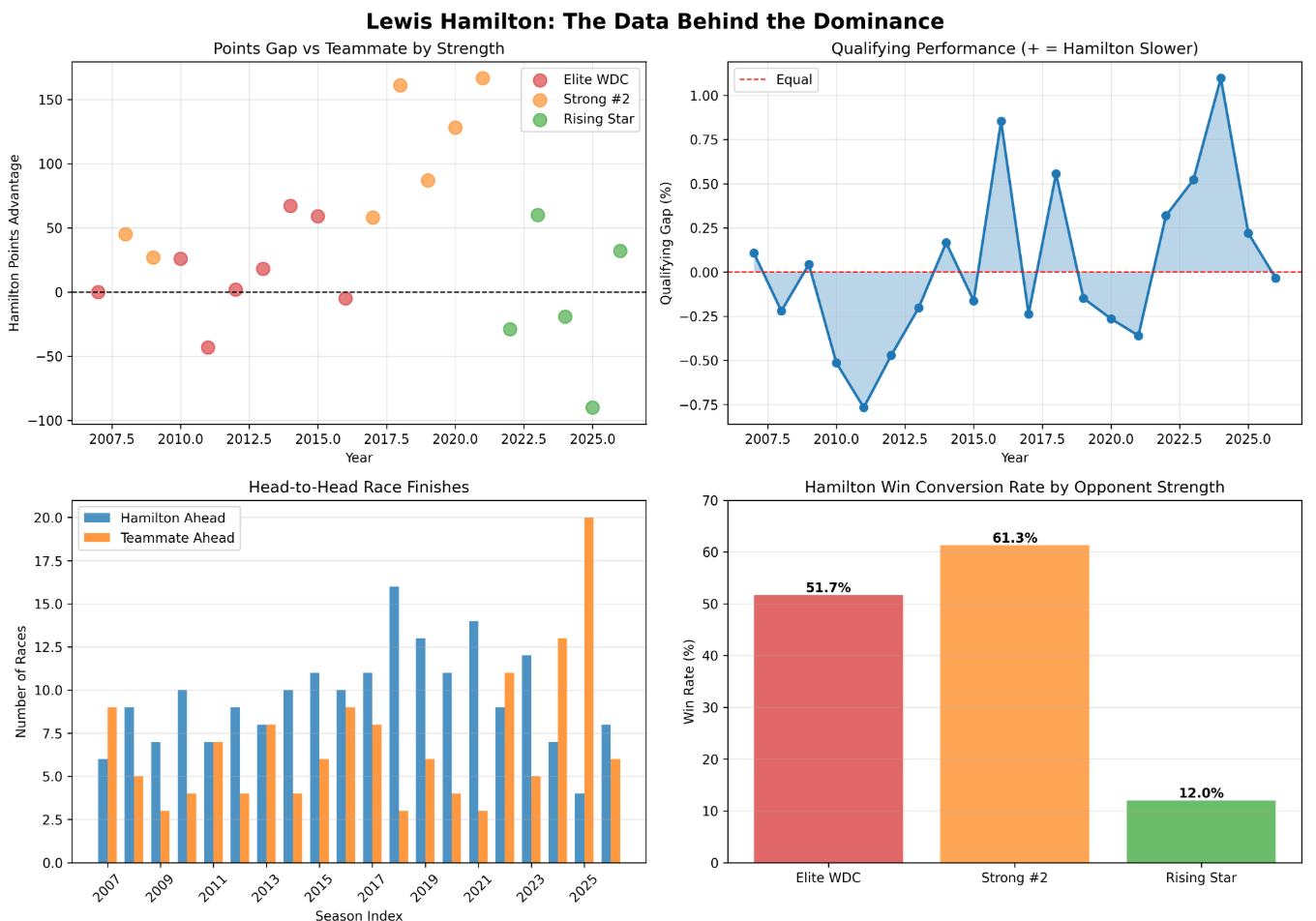
Its verdict? "The data is damning."
It was the most confident answer of the four, and the most wrong. It even contradicted itself: its earlier sections showed Hamilton matching or beating his teammates, and then it concluded the opposite.
What everyone needs to take from this
Confidence ran opposite to accuracy. The two strongest models hedged the most carefully. The weakest gave the boldest, most quotable conclusion. If someone had only read the summaries, they may have picked the wrong one.
That's the real risk with using a cheaper model for work that matters. It won't tell you it's out of its depth and in fact will sound more certain, not less.
The price per token isn't the price per job. Opus costs twice as much per token as Sonnet, yet the full job cost only 25 cents more. It also finished in half the time and produced the better answer. It read less and wasted less, because it knew what it was looking for.
Haiku saved $1.64 against Opus and produced an answer I couldn't use. Nobody would call that a saving.
The pattern will surprise anyone who assumes "cheaper and faster" always go together. On this task, the more capable model was the quickest to a good answer.
On all of them, they still require the subject matter expert ensuring the information is correct and fit for purpose before publishing it anywhere.
The routers are coming
This is the development worth watching. The industry has noticed that asking every employee to pick the right model for every task doesn't necessarily work.
People default to the biggest model, or to whatever was selected last time. The AI equivalent of using a sledgehammer to crack a nut.
The answer emerging is the "router": software that looks at each request and decides which model should handle it. Think of it as a delegation expert who reads each incoming job and allocates it to the right person.
Routers are arriving from several directions:
- Coding tools. Factory, a software development tools company, launched a router in June that picks a model for each task automatically. It claims a saving of 20–25% on AI spend without a drop in quality, and it hands the work up to a stronger model if the first one struggles.
- Model marketplaces. OpenRouter, a service offering hundreds of AI models through one account, has an "Auto" option. It reads your request and picks a model based on what its users generally choose for that kind of work, at no extra charge.
- The big cloud platforms. Microsoft and Amazon now offer routing inside their own AI services.
- Anthropic itself. Claude already switches models for you in some cases. Questions on biology or security asked of Fable are answered by Opus instead (but this tends to be more for security than anything).
These are genuinely useful and could be more widely used in the future. It takes a decision most staff aren't equipped to make and make it consistently. But, I suspect the accuracy of the routing will greatly depend on the quality of the initial prompt you give it.
Now look back at my test. A router tuned to save money could easily have sent that job to Haiku. The business would have saved $1.64 and received a confident, wrong answer.
That's why every leader should be asking one question: can you see which model did the work?
Some routers show you and others choose silently. One industry comparison warns that routing you can't inspect becomes a blind spot. Researchers are already describing it as a question of trust. If a client challenges a piece of analysis, "the AI did it" won't satisfy them. "A router picked a model and we don't know which" is worse.
What to take into your next meeting
- For any analysis you'll put your name to, run it twice. Use two strong models, or the same model twice with a fresh start. Where the numbers agree, you can probably rely on them. Where they don't, that's where to look. Two independent answers that match tell you more than one answer that says "I checked".
- Measure the cost of the finished job, not the price per word. Ask whoever manages your AI spend what a typical task actually costs on each model. The gap between the cheapest and the best may be pennies, while the cost of a wrong answer is not. You can always try use the "/cost" message after the work has been completed to get the cost in that window too.
- Set a sensible default, then escalate deliberately. The all-rounder, Sonnet, is fine for everyday drafting. For analysis that informs a decision, test a stronger model before assuming you can't afford it.
- Ask any AI supplier one question: if your product chooses the model for us, can we see which one it chose and why?
- Match the checking to the stakes. Anthropic's own guidance is to check a result in proportion to what's riding on it. That applies to every model, the most capable included.
None of this replaces the need to actually understand what it is you are asking the model to do though. Subject matter expertise is more relevant now in the age of overly confident "intelligent" automation.
A closing thought
The businesses that get the most from AI won't be the ones using the most powerful model for everything, or the cheapest. They'll be the ones that treat the choice the way good leaders treat delegation: knowing the job, knowing the people, and matching one to the other.
In my test, the most confident suspect was the one that got it wrong and any good leader worth their salt will have worked with someone like that in the past.
I've said this before and I'll say it again: using an AI system is similar to mastering how to delegate effectively, and really understanding your team's strengths and weaknesses for specific tasks.
Routers will increasingly make this choice for us. That's fine, as long as someone in the business still understands the choices being made.
Until then, having an understanding of the amazing capabilities and real limitations of the tools you're using is paramount as you start to lean on them more and more to support your business operations.
♻️ Enjoy this? Repost to your network if you found this useful.
🔔 Follow Martin Wheatley for more AI for leadership.
✅ 𝙃𝙚𝙡𝙥𝙞𝙣𝙜 𝙡𝙚𝙖𝙙𝙚𝙧𝙨 𝙗𝙚𝙘𝙤𝙢𝙚 𝘼𝙄-𝙘𝙤𝙣𝙛𝙞𝙙𝙚𝙣𝙩. Putting AI to work with your people, without replacing what makes them great.
⭐️ If that's the conversation you're interested in having, leave a comment, drop a DM, book a call, or visit my website.
Sources
Anthropic
- Models overview, Claude Platform Docs: https://platform.claude.com/docs/en/models/overview
- Choosing the right Claude model, Claude Academy: https://academy.claude.com/tutorials/choosing-the-right-claude-model
Routers
- Factory Router announcement, Factory.ai (June 2026): https://factory.ai/news/factory-router
- Auto Router documentation, OpenRouter: https://openrouter.ai/docs/guides/routing/routers/auto-router
- 9 Best LLM Routers and Model Routing Tools in 2026, Entelligence: https://entelligence.ai/blogs/9-best-llm-routers-and-model-routing-tools-in-2026
- Model Routing as a Trust Problem: Route Receipts for Adaptive AI Systems (arXiv): https://arxiv.org/pdf/2605.01710
Test data