
Martin Wheatley
Founder, The AI Leader Lab · CIMA Qualified · Managing Director, Rawson Ellis
Sometime this month, somebody in one of your meetings will say "agentic AI", and half the room will nod along. Some have heard of it before, others not so much.
So lets make sense of the terminology bouncing around everywhere. Forget the technology for ten minutes and think about your favourite restaurant, and more specifically, the kitchen in that restaurant.
A kitchen is one of the few places nearly everyone has eaten from, and most of us have run a scrappy home version of on Christmas Day, short of oven space and patience.
Every AI term I hear leaders wrestling with already has a job in one. And the model (Fable, Sonnet, Sol, Luna) , the bit everyone talks about, is just one of the chefs in a busy kitchen.
The kitchen, quickly
Strip back a serious kitchen and it looks like this:
- There's a brigade of chefs (sous, pastry etc), the talent everyone raves about, each with their own station and their own kit.
- There's the pantry, stocked or bare.
- There's a recipe book the kitchen trusts more than anyone's memory.
- There's the plan for the evening taped to the wall.
- And there's the executive chef, who runs and coordinates everything: who gets which order and which kit, and the pass, where every plate is checked before it goes out.
Keep that picture in mind, and I'll explain how every AI term below is one of those jobs.
The model: a chef, and kitchens carry more than one
When somebody says AI model, or LLM (Large Language Model), they mean a chef.
ChatGPT, Claude, Copilot and Gemini are the famous providers of models, and behind each works a brigade rather than a single cook. Some are pastry chefs, superb at one thing. Some are fast short-order cooks, cheap and quick for the simple stuff. And there's usually one slow, expensive perfectionist you save for the dish that matters.
If you've ever squinted at the dropdown of model names in ChatGPT and wondered what it's for, it's this. You're choosing a chef to cook the right dish you want.
Some you may recognise:
- Anthropic Claude: Fable 5, Opus, Sonnet, Haiku
- OpenAI ChatGPT: Sol, Luna, Terra
- Google Gemini: Gemini 3.5
And different models work best for different things:
- Claude Fable & Opus, and ChatGPT Sol for complex problems, coding and analysis.
- Claude Sonnet and OpenAI Luna for everyday tasks, writing and processes;
- Claude Haiku and ChatGPT Luna for easy, fast short answers.
Generative AI just means these chefs make something new to order: a paragraph, a plan, a picture, a first draft. It's called generative because it generates something new.
But a brilliant chef standing alone in an empty kitchen feeds nobody. Everything else in this piece is the kitchen around them, and the whole kitchen is where I think the business value actually lives.
Prompting: the order
A prompt is the order that gets given to the chef. Everyone in your business who's typed a question into ChatGPT has made an order.
And the kitchen truth applies. "Surprise me" gets you the chef's idea of dinner, not yours. Vague and generic in, vague and generic out.
There's a difference between "make me a cake" and "a lemon cake for twelve, not too sweet, here's a photo of the one I loved last year".
Same chef but a completely different outcome, driven from the instructions you gave.
Prompt engineering is that skill: saying precisely what you want back and showing an example of what good looks like. Some prompts can be pages in length, some prompts can be short, it really depends on your use case and how specific you need the output.
The more you structure your prompt, in an easy to understand way, similar to how you would delegate a specific task to a colleague, the better the model will read and understand what you want.
Context engineering: the briefing and the pantry
Because the chef never cooks from the order alone. They cook from everything around it. Whether they know it's a birthday. Whether anyone mentioned the nut allergy. What's actually in the pantry.
Context engineering is deciding what the AI has in front of it at the moment you ask. Which documents it can open. Whether it's seeing your actual numbers or just what is on the public internet and the data it's been trained on.
In my experience, most disappointing AI output is a briefing problem rather than an intelligence problem. The same meal order, with an allergy mentioned to the waiter, produces a different and safer dinner.
So if you want a better, more specific output from your AI of choice, give it safe access to the context it needs to truly help you.
RAG (retrieval augmented generation): cooking from the recipe book, not from memory
A confident chef can cook from memory but memory alone could also be why the signature dish comes out slightly different every time.
RAG, means the AI checks a library you've given it before answering. Your policies, your product sheets, your price list, your past proposals: the business equivalent of the kitchen's own recipe book.
It answers from what it found there, not from a vague memory of everything it's ever read.
Fewer confident inventions and more "according to your own document".
Vectors: are how the recipe box is filed
How does it pull the right recipe, though?
Not alphabetically. A good kitchen can be asked for "something for a dairy-free birthday" and reach straight for the card titled "vegan sponge", because the box is organised by what dishes are, not what they're called.
Vectors do that for the AI. They turn what a passage means into numbers, so the system can tell that two differently worded things are about the same subject. It's why a search for "staff holiday policy" finds the document called "annual leave guidance". Filing by meaning rather than by exact words. That's the machinery under the lid of RAG.
Tools: the appliances at each station
A chef without a kitchen can still talk you through the dish, beautifully. But until you give them the station, the oven, the knives and the fryer, they can't actually cook anything.
Tools are the AI's kitchen utensils.
On its own, a model can only produce words. Give it tools, the diary it can read, the email it can send, the spreadsheet it can open, the payment it can trigger, and it can do things rather than describe them.
You'll sometimes hear these as "integrations" or "connectors". Both mean the same thing, and it's essentially just giving the model access to take actions within other programs to help you get work done.
Nobody hands every chef every appliance. Which chef gets the blowtorch is a decision, not a default, and deciding it is somebody's job. We'll meet them shortly.
Agentic AI: catering the wedding, not cooking a dish
Everything so far is one order for one meal.
Agentic AI is a different arrangement altogether, and I'd say it's what will matter most to how leaders will work over the next few years.
You don't hand a wedding caterer a recipe, you hand them to create what you need for the whole day, a goal for them to fulfill.
A dinner for 120 people, three courses, one vegan, two gluten intolerant, within a budget of £X, being hosted in that marquee. Then they plan the menu, buy the ingredients, cook, adapt when the ovens run cold, and check in with you when something big changes.
That's an agent. Not a better answer, but a delegated outcome that gets delivered to you.
Which sounds either liberating or alarming. Probably both. What makes it workable is the machinery around it, and that's the next three terms.
Skills: the plan taped to the kitchen wall
Before a big service, the plan is already drawn, forks included. If the fish doesn't arrive, the beef becomes the special. If the numbers jump from 80 to 120, the desserts get simpler.
In AI, a skill is just that drawn plan: what happens first, what comes next, and where the evening is allowed to fork. A detailed process document that guides the AI what to do and in what order.
In business terms it is a standard operating procedure (SOP) and it is what guides the AI through what steps to take. Just like in real life, the best SOPs are the ones that are clear, straightforward and aligned to a handful of steps within a task to be completed. You can daisy-chain several skills together to create longer processes just like you would in real life.
And the easiest way to create a repeatable skill, is to ask the AI to help you create it.
Loops: tasting as you go
This term seems to be everywhere at the minute within AI coding circles and is a simple concept when you boil it down.
In a kitchen, nobody seasons a sauce once. They taste, adjust, and taste again until the balance is right.
An agent works the same way with a loop: try something, look at the result, correct, go again. When a vendor says their agent "iterates", that's all they mean.
Giving an agent a goal and asking it to loop means it will keep tasting their recipe until it hits the goal you set.
This sounds fantastic, but if left unchecked you could end up with an agent going round in circles trying to perfect something that it never feels is perfected.
The harness: the executive chef
Every serious kitchen has one person who rarely cooks. The executive chef runs the entire kitchen: which chef gets which order, what kit each station is given, the house rules about what nobody touches, how much rope a new hire gets until trust is earned, and the pass, where every plate is checked before it leaves the kitchen.
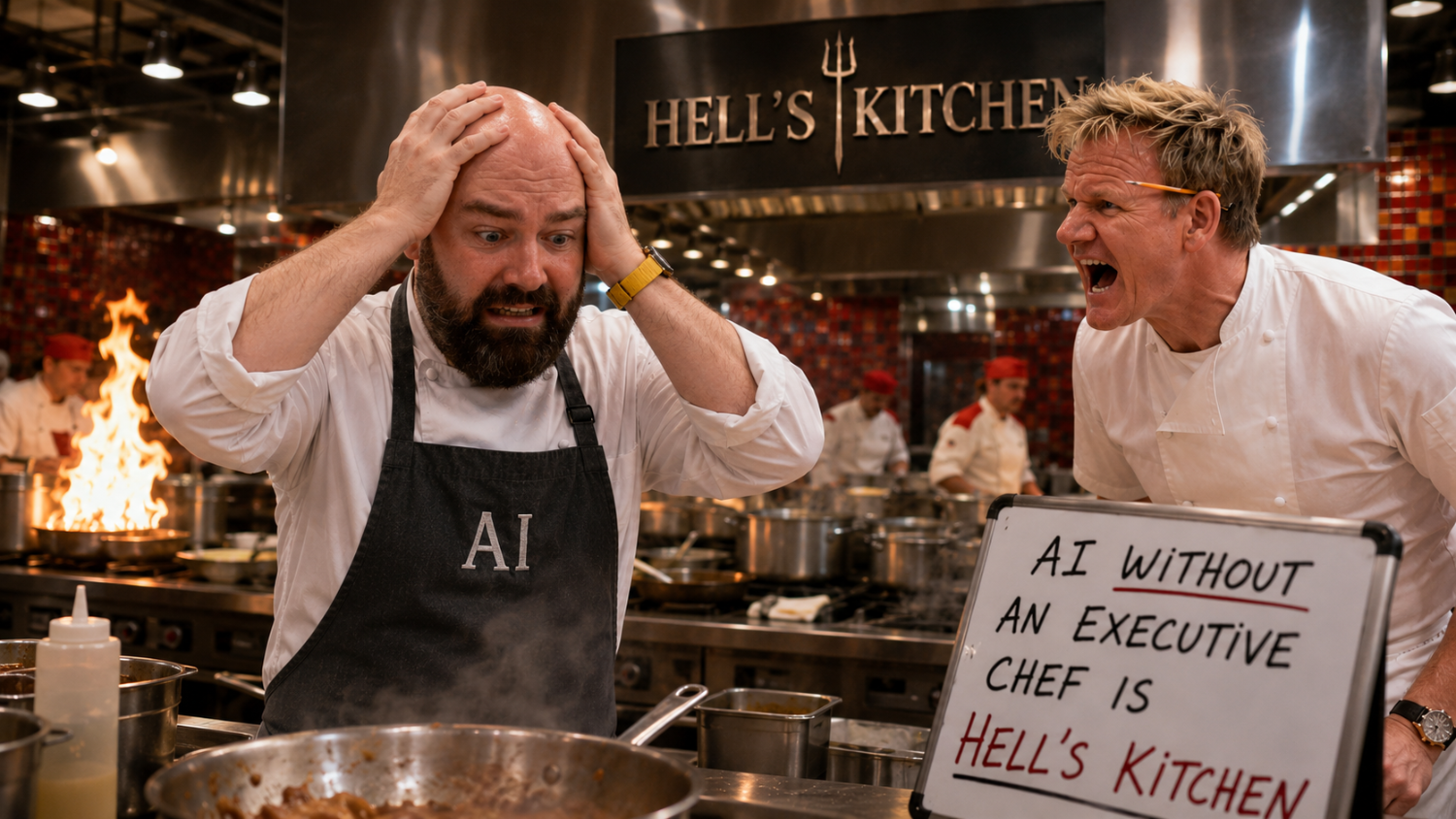
Hell's Kitchen was never a show about people who can't cook; the drama is what a kitchen full of talent produces when nobody is properly running it. Swap the stations for AI tools and you've got a fair description of many businesses right now, usually filed under the politer heading of "we've rolled out the licences".
Harness engineering, is specifying that role for AI. Providing the environment for what access you give, what context you give, how you monitor the outputs etc.
One honest wrinkle: in AI the executive chef is mostly built rather than hired, rules and software your team or your vendor sets up. But the job description is identical: route each piece of work to the right model, hand out the tools, enforce the rules, check what leaves. Once AI starts doing work rather than answering questions, this role matters more than any chef in the building.
Open and closed weights: the vault and the printed recipe
Last one, and it sits alongside every conversation about cost and data.
Coca-Cola's actual recipe has been locked in a vault since 1925, these days a purpose-built one in Atlanta that you can go and stare at.
You can buy the drink on any high street on earth. But the recipe, you could never buy.
That's a closed-weight model. The recipe, which in AI is called the weights, stays locked in the supplier's vault. You buy what their kitchen produces, they run the kitchen, and your order travels to their premises and back. ChatGPT, Claude, Copilot and Gemini all work this way.
An open-weight model is Mary Berry's Victoria sponge. The recipe is published, free, and anyone can cook it at home. Which sounds like the bargain until you remember what home cooking involves. Your kitchen, your ingredients, your gas bill, your washing up, and when it collapses at seven with guests arriving, your problem.
The recipe is free but the meal isn't. Most businesses eat out, and for most that's the right call for now but it is becoming a larger question as the models develop.
The questions I've started asking
None of this makes anybody technical but what the kitchen analogy gives you is a way of finding the substance in a pitch or a project update.
What's in the pantry when it answers? That's context. If the answer amounts to "whatever's typed in the chat window", expect generic cooking.
Is it cooking from our recipe book or from memory? That's RAG. "It's trained on the whole internet" is not an answer about your business.
Which appliances has it actually been given? That's tools. An AI without them can only describe the work, so the demo that sends the invoice is a different tool from the one that drafts it.
Who's the executive chef, and what leaves the kitchen without crossing the pass? That's the harness. If the answer is a blank look, the kitchen has talent and no management.
Are we eating at their restaurant or cooking in our own kitchen? That's open versus closed weights, and it's the question your data protection lead is hoping somebody asks.
If you're in financial services or insurance, there's a sharper point to all this. The Bank of England and the FCA said in their joint statement on frontier AI in May that board-level understanding of AI is part of the job now. Nobody on a board will ever be asked to explain a vector but understanding these concepts to understand how the technology works at a general level is important.
Where this goes
Everyone could hire similar chefs, and your competitors already have.
What nobody can copy overnight is the restaurant: your larder, your recipe book, and the way your executive chef runs the kitchen. That's where you'll differ, and none of it is technical work; it's operational work, which is the kind leaders already know how to run.
If you'd rather have that conversation about your own kitchen than read another glossary, my calendar is here: book a call.
And a smaller ask if you're not there yet. Forward this to the person who signed off the AI licences last year, and ask them who's standing on the pass.
♻️ Enjoy this? Repost to your network if you found this useful.
🔔 Follow Martin Wheatley for more AI for leadership.
✅ 𝙃𝙚𝙡𝙥𝙞𝙣𝙜 𝙡𝙚𝙖𝙙𝙚𝙧𝙨 𝙗𝙚𝙘𝙤𝙢𝙚 𝘼𝙄-𝙘𝙤𝙣𝙛𝙞𝙙𝙚𝙣𝙩. Putting AI to work with your people, without replacing what makes them great.
⭐️ If that's the conversation you're interested in having, leave a comment, drop a DM, book a call, or visit my website.
Sources
- The Coca-Cola Company, Coca-Cola's formula is at the World of Coca-Cola and press release, December 2011: the formula moved to a purpose-built vault at the World of Coca-Cola, Atlanta, in December 2011, after 86 years in a bank vault
- Bank of England, FCA and HM Treasury, Joint statement on frontier AI models and cyber resilience, 15 May 2026